.svg)

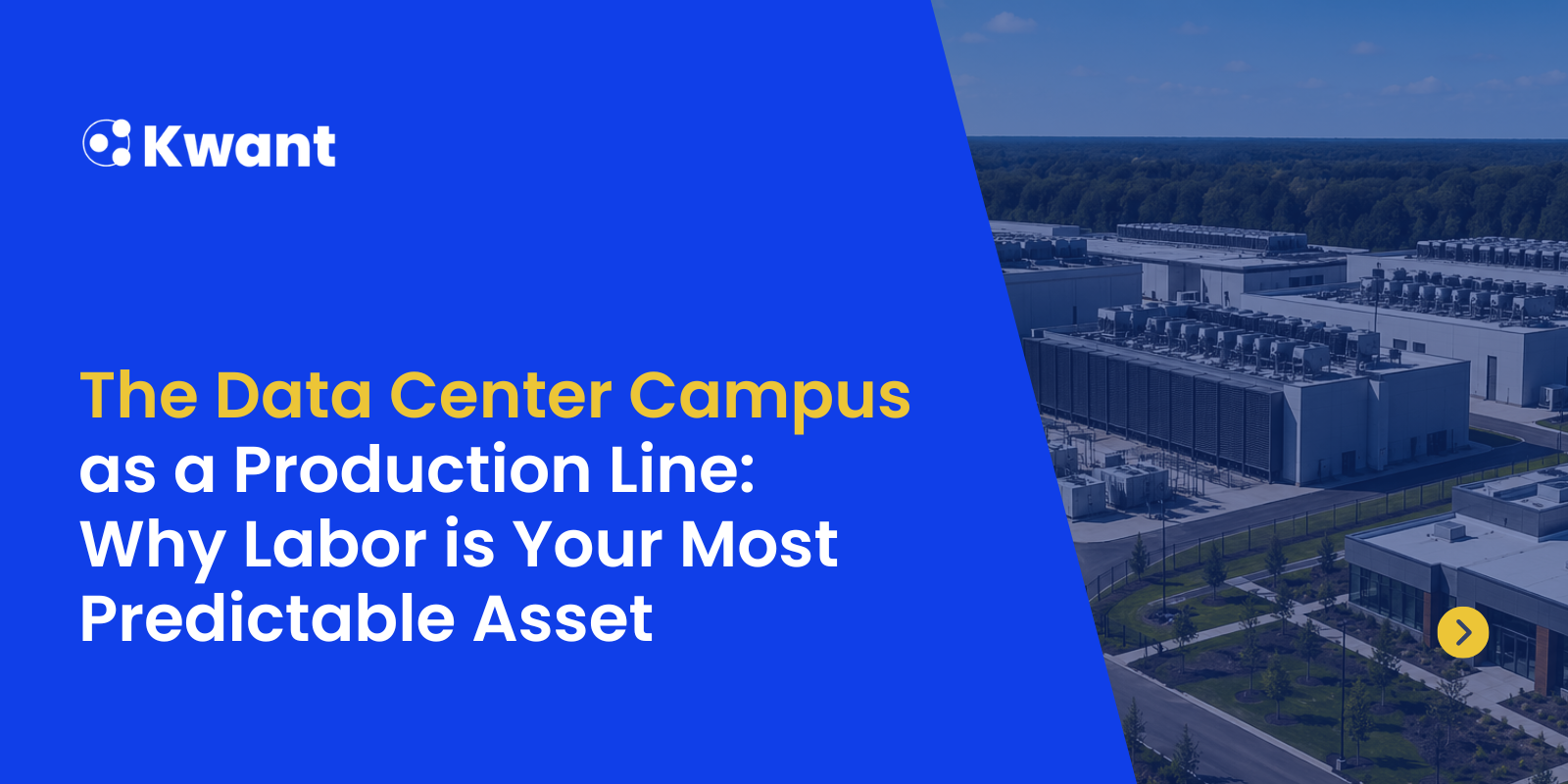


In the hyperscale race of 2026, "progress" is often measured by what we can see. We look at 360-degree photo captures or BIM models to see if the walls are up or the racks are in. Platforms like Cupix do an incredible job of showing us the visual truth of a site.
But there is a second, often invisible layer of progress that determines whether a project actually hits its financial milestones: The Workforce. For a modern data center construction workforce management platform, that invisible layer is not a luxury. It is the difference between a campus that delivers on its financial model and one that absorbs overruns that compound across every subsequent building in the program.
Modern hyperscale campuses can host 4,000 to 5,000 workers simultaneously across multiple concurrent structures. At that density, a 20% labor hour overrun in one building does not stay isolated. It propagates across the program through trade stacking, sequencing conflicts, and subcontractor scheduling collisions that no visual progress tool can detect.
For a modern Data Center Owner or General Contractor, the question isn't just "is the conduit installed?" It’s "did it take 400 hours instead of the budgeted 300? And if so, why?" To answer that, we have to stop managing projects and start managing campuses.
Kwant's platform is currently deployed across data center campuses with Mortenson, Turner, Gilbane, Yates Construction, and other top-tier GCs, delivering real-time workforce intelligence at the scale that hyperscale builds demand.
The Missing Link in Productivity: Labor vs. Visuals
While visual tools tell you the "what," a sophisticated workforce management platform tells you the "how." By analyzing budgeted labor resources against real-time hours on-site, you move from reactive management to predictive labor analytics.
Predictive labor analytics means using real-time hours-worked data against budgeted crew productivity benchmarks to identify overruns while there is still time to correct them on the current structure, before the same crew configuration is deployed on the next one. If a framing crew is burning through hours 20% faster than planned on Building A, that’s not just a reporting issue, it’s an early signal. Maybe the details are too complex, sequencing is off, or the crew mix isn’t right. Whatever the cause, you can take that lesson and adjust before Building B starts. This isn't just "tracking"; it's financial optimization.
Managing the Campus, Not the Project
On a modern hyperscale campus, Building A might be in commissioning while Building C is just hitting vertical. The complexity doesn't just add up; it multiplies. This is where the "check-the-box" access control vendors fail—they provide a gate, but they don't provide a Campus View.
A Campus View provides a single enterprise dashboard that displays onsite insights. Data like labor density, hours logged, zone-specific headcounts and trade-level productivity benchmarks are recorded across every structure on the campus simultaneously. So, a project executive can see the full campus picture in a single view without opening four separate project reports to understand relationship between Building A's commissioning labor draw and Building C's structural framing demands. Along with the ability to drill down into any structure, zone, or trade classification in real time.
Basic access control vendors can tell you a worker arrived. They cannot tell you whether the 120 electricians who arrived this morning were split correctly between the two Data Halls that both need them today. They cannot tell you whether your MEP(Mechanical, Electrical & Plumbing) subcontractor is on pace to hit their contractual peak staffing commitment by end of week. And they cannot tell you whether the sequencing pattern that cost you $2 million in unrecovered labor on Building A is about to repeat on Building B. A campus-level workforce management platform can do all three.
1. The "Colo Compare" Strategy
One of the most significant advantages of high-standard data center workforce management is the ability to track labor by specific zone in real-time.
- The Benchmark: Imagine one Enterprise Dashboard comparing Colo 1 vs. Colo 2. Are the electrical trades on the new hall hitting the same productivity benchmarks as the previous one? If not, is the variance a crew mix problem, a sequencing problem, or a scope complexity problem? The answer determines whether you adjust the current structure or adjust the plan for the next one.
- The Risk Mitigation: With high-speed schedules, trade overlap is inevitable. Having workforce visibility into exactly how many workers are in a specific zone prevents "trade stacking" that kills your labor budget and creates safety hazards. It occurs when two or more subcontractor crews are scheduled in the same physical zone simultaneously. Trade stacking creates a dual liability: both crews impede each other's productivity, and in confined or energized spaces, crowd density itself becomes a safety hazard trigger.
- The Pay Application Validation: When labor hours are tracked by zone and structure in real time, the GC holds an independent data source against which to validate subcontractor pay app submissions. If a subcontractor submits a pay app claiming 500 hours of electrical work in Data Hall B during a given period and the access and location data shows 380 hours of verified presence in that zone, that discrepancy is resolved before the pay app is approved rather than discovered in a post-project audit. For a campus program with dozens of concurrent subcontractor packages, this capability alone recovers more cost than the platform investment requires.
This Colo Compare capability is delivered through Kwant's ZoneIQ product, which provides zone-based labor intelligence, real-time heatmaps, and trade-level drill-down across every structure on the campus simultaneously.
2. Instant Feedback via Heatmaps
Data is only as good as its delivery. A spreadsheet of 4,000 names is a headache; a Workforce Heatmap is a strategy. By utilizing Real-Time Location Systems (RTLS), you get a visual "pulse" of the campus that updates continuously as workers move through zones across every structure.
- Volume Insights: The heatmap immediately surfaces which buildings are over-resourced and which are lagging their labor plan. Rather than discovering a staffing imbalance in a Friday coordination meeting, the project executive sees it at 8:00 AM on Tuesday and can redirect resources before a half-day of production is lost. Workforce visibility at this resolution means the information that used to arrive three days late now arrives in real time, when it can still change the outcome.
- Drill Down on Contractors: Filter your heat maps by company or even workers to visualize their time spent onsite, allowing you to easily identify inefficiencies, logistical patterns, and true production hours. Which subcontractor is consistently arriving 45 minutes after shift start despite badging in on time? Which crew is spending two hours per day in a staging area that should be taking 20 minutes? These inefficiencies are invisible to any gate-only system and visible immediately in a filtered heatmap view. For a GC managing a program with 40 or more active subcontractor firms across a campus, this filtering capability is the difference between managing contracts on faith and managing them on evidence.
Real-Time Location Systems for construction connect physical worker presence to the zone-level data layer that makes the Colo Compare and heatmap strategies operationally useful. Without RTLS, workforce visibility stops at the gate. With it, it extends to every zone, every structure, and every shift window across the full campus program.
The Hidden Labor Risk: Fatigue Across the Program Schedule
Campus-scale builds create a fatigue exposure that single-structure projects do not. When the same electrical or commissioning crew is drawn across two concurrent structures to meet competing schedule demands, their cumulative hours become a risk variable that neither a traditional access system nor a visual progress tool can detect.
A commissioning engineer who has worked three consecutive extended shifts in a high-voltage environment does not just represent a safety liability. They represent a rework risk when errors from fatigue produce defects that delay go-live by days or weeks. On a campus where a data center operator is paying for dark fiber and idle rack capacity while waiting for a delayed commissioning sign-off, that rework cost is not a construction line item. It is an operator cost that the GC's relationship absorbs.
Kwant's Fatigue Management module tracks each worker's consecutive shift hours in high-risk zones and surfaces proactive alerts before the next shift begins, not after an incident report is filed. For a project executive managing a multi-building program on compressed delivery timelines, this is not a safety feature in isolation. It is a schedule protection mechanism that prevents the human cost of overextension from becoming a project cost.
Strengthening the Ecosystem: The Kwant + HammerTech Partnership
No single piece of tech can solve every jobsite challenge, which is why the "Higher Standard" data center construction workforce management focuses on integration. Take our partnership with HammerTech. They handle the "what" of safety—permits, inductions, and checklists. By integrating Kwant’s RTLS data, you unlock a new dimension:
- HammerTech handles the what of safety: permits, inductions, and checklists. They ensure that every worker on the campus has completed the required safety protocols before they enter a work zone. By integrating Kwant's RTLS construction data into that compliance layer, a new dimension opens that neither platform delivers alone.
- HammerTech ensures the worker is compliant. Kwant ensures the worker is in the right zone, at the right time, and creates a historical record to validate reporting, pay apps, and captures the labor productivity benchmarks that inform the preconstruction estimate for the next campus in the program.
For the project manager reviewing pay applications, the integrated record is an independent verification layer. For the project executive presenting labor utilization reports to the owner, it is an audit-ready data source. For the preconstruction director estimating the next build, it is the calibrated baseline that replaces industry-average productivity assumptions with actuals from the GC's own program history. All three outcomes matter to different decision-makers in the same organization, and the integration delivers all three simultaneously.
Turning Program History Into Repeatable Precision: Portfolio Analytics
The production line analogy only holds if data from each building actually feeds the estimate for the next one. That is the function of Portfolio Analytics.
By capturing actual labor productivity benchmarks, trade density patterns, zone-level hour accumulations, and subcontractor performance records across every completed structure in the program, the preconstruction team building the estimate for the next campus has a data-calibrated baseline rather than an industry-average assumption. The difference between an estimate built on historical actuals from your own builds and one built on generic productivity tables is the difference between a competitive number that protects margin and a bid that either loses the work or gives it away.
For GCs operating at the scale of multiple concurrent campus programs, this capability compounds. Each completed building becomes a data point. Each completed campus becomes a benchmark. Each subsequent program is estimated, managed, and delivered with greater precision because the historical record is not sitting in a project manager's personal spreadsheet. It is structured, queryable, and accessible to every estimator and project executive in the organization.
The Cost of "Access Control Lite"
Labor costs on a modern hyperscale data center campus represent 30 to 40 percent of total project cost, with a single campus delivering a labor spend of hundreds of millions of dollars over a two to three year build program. Against that baseline, the cost differential between a basic badge-in system and an enterprise workforce management platform is not a cost center comparison. It is a risk management ratio.
If a 20% labor hour overrun on Building A costs the GC $2 million in unrecovered labor on a $10 million labor package, and that same crew configuration and sequencing pattern is deployed without correction on Buildings B, C, and D, the total exposure from that single undetected inefficiency is $8 million by the end of the program. A workforce management platform that flags the overrun during Building A costs a fraction of that figure. The access control lite vendor never flags it at all.
In the market for construction labor productivity tools, it’s tempting to lean toward the lowest-priced badge-in system. However, access control alone is not workforce management. A budget-friendly turnstile might tell you a worker arrived, but it cannot provide the instant reporting through AI needed to catch a scheduling conflict. It won't tell you the "why" behind a cost overrun. The real ROI isn't in the hardware at the gate; it’s in the Enterprise Data that turns a fragmented build into a repeatable, optimized machine.
The real ROI is not in the hardware at the gate. It is in the workforce intelligence that makes every subsequent build on your program more predictable, more accurate, and more profitable than the last. Kwant's AI Reporting and Insights capabilities deliver that intelligence automatically, replacing hours of manual data compilation with real-time analytics that are ready when the project executive needs them, not three days after the weekly reporting cycle closes.
The Insight: Don't Just Build, Optimize
Thinking of data center site access control as a security tool is a 20th-century mindset. In 2026, it is your most powerful reporting tool, labor productivity benchmark engine and most defensible compliance record.
By leveraging an enterprise-level dashboard ZoneIQ workforce heatmaps, RTLS construction data, and AI-powered predictive labor analytics, a project executive isn’t just "checking badges". They are unlocking the data that allows you to build faster, safer, and with a level of precision that makes every subsequent build more profitable than the last.
The GCs who are consistently delivering hyperscale programs on schedule are not the ones with the cheapest access solution at the gate. They are the ones who recognized early that data center construction workforce management is a financial optimization platform in disguise, and that the data it generates has a direct line to schedule performance, compliance posture, subcontractor accountability, and program-level cost control.
Kwant is currently deployed across campuses managed by Mortenson, Turner, Gilbane, Yates Construction, Suffolk, Harvey Cleary, and other leading GCs in the mission-critical sector. A case study documenting Kwant's deployment across four of the largest U.S. data center builders .
Do not just build the campus. Optimize it.
See how Kwant's data center construction workforce management platform works at scalel, or request a demo tailored to your current program.
Frequently Asked Questions
1. What is data center construction workforce management?
Data center construction workforce management is the practice of capturing, analyzing, and acting on real-time labor data across a hyperscale campus build to optimize crew productivity, enforce zone-level access and compliance, validate subcontractor pay applications, and build a historical record that improves the accuracy of future program estimates. It goes beyond gate-level access control to provide a campus-wide intelligence layer that covers every structure, zone, trade, and shift window in the program simultaneously.
2. How is workforce management different from basic access control on a data center construction?
Basic access control confirms that a worker arrived on site. Enterprise workforce management confirms where they went, how long they were in each zone, whether their productivity matched the budgeted benchmark, whether their certifications were current at the time of entry, and whether their hours in high-risk zones are approaching fatigue thresholds. On a campus with 4,000 to 5,000 workers across multiple concurrent structures, the delta between those two capabilities is measured in millions of dollars of recovered or lost program cost.
3. What is trade stacking and why does it matter on a hyperscale campus?
Trade stacking occurs when two or more subcontractor crews are scheduled into the same physical zone simultaneously, typically because competing schedule demands pull multiple trades into the same space at the same time. On a data center build, trade stacking in an MEP corridor or Data Hall creates a dual liability: crew productivity for both teams drops because they impede each other's work, and in confined or energized spaces the crowd density itself triggers safety exposure. Real-time zone-level workforce visibility prevents trade stacking by surfacing it before it occurs rather than reporting it after the fact.
4. What is predictive labor analytics in the context of data center construction management?
Predictive labor analytics means using real-time hours-worked data against budgeted crew productivity benchmarks to identify overruns while there is still time to correct them on the current structure and apply the lesson to the next one. Rather than discovering a labor overrun in a monthly cost report, predictive analytics surfaces the signal during the shift window when the correction is still actionable.
5. How does RTLS construction technology support workforce visibility on a hyperscale campus?
Real-Time Location Systems for construction extend workforce visibility from the entry gate to every zone across every structure on the campus. Each worker's location is tracked continuously throughout the shift, producing a time-in-zone record that feeds both the labor productivity analysis and the safety compliance layer. When integrated with zone authorization rules, RTLS also enforces access boundaries automatically, ensuring that workers in the civil package cannot enter a Data Hall or energized Electrical Zone without triggering an immediate supervisor alert.
6. How does workforce management data support subcontractor pay application validation?
Every badge-in and zone-entry event creates a time-stamped, zone-attributed record tied to an individual worker identity. When a subcontractor submits a pay application claiming hours in a specific zone during a specific period, the GC has an independent data record to verify those hours against actual presence. Discrepancies are identified before the pay application is approved rather than discovered in post-project reconciliation, protecting the GC's labor budget and creating a contractual compliance record for every subcontractor on the program.
7. What role does fatigue management play in data center construction workforce management?
On a campus program where specialized crews are deployed across concurrent structures on compressed timelines, fatigue is both a safety risk and a rework risk. Workers in high-voltage, confined-space, or commissioning environments who accumulate excessive consecutive shift hours produce a higher rate of errors that require costly rework. Fatigue management integrated with access control surfaces these risks before the worker begins the next shift, preventing the human and financial cost of fatigue-related incidents and defects.
%20(1).svg)


