.svg)



In 2026, the gap between how a construction team plans its equipment logistics and how they manage mobile badging for construction site entry is one of the most overlooked productivity drains in the industry. Kwant supports thousands of workers across active construction sites every day, delivering real-time construction site access management systems that replace the guesswork of manual headcounts with verified, zone-attributed workforce intelligence.
Inside the construction industry, we are obsessed with "Day One" readiness. We plan our cranes, our concrete pours, and our materials down to the hour. Yet, when it comes to construction gate management, we often rely on hardware that takes weeks to ship, hours to configure, and seconds to fail when the power goes out.
For years, the industry standard for site entry tracking in construction has been the turnstile or the specialized handheld scanner. But as sites become more complex and schedules more aggressive, these "fixed" solutions are no longer enough.
The future of a secure, digital jobsite isn't just at the gate—it’s in the pocket of every supervisor on the ground.
The Hardware Trap: Why Scanners are Yesterday’s News
Traditional handheld badge scanners on a mid-size construction site typically represent a combined procurement, maintenance, and replacement cost of several thousand dollars per project cycle, before factoring in the days of shipping lead time that delay site readiness when a device is damaged or lost during mobilization. On projects where schedule compression is the defining challenge, that delay is not a minor inconvenience. It is a Day One exposure.
Traditional handheld scanners are the hidden "tax" of construction technology. They are expensive, easily lost, and require their own charging ecosystems. Most providers still charge you for these devices, essentially forcing you to pay for the privilege of doing your job. Relying on disconnected, manual systems creates bottlenecks that compound across every shift, every subcontractor rotation, and every project phase.
By shifting to mobile badging for construction, you eliminate the "shipping and setup" delay. A mobile app transforms any smartphone into a powerful tool for contractor badge management, ready to go the moment your team steps on-site. No dedicated hardware budget. No waiting on a courier. No charging cradle in the trailer.
Mobile Badging for Construction Across Every Project Type and Vertical
Whether you are managing a small-scale $10M project where a turnstile does not make financial sense, or a multi-billion dollar build with layers of security, including mission-critical data center campuses, airport infrastructure projects, oil and gas facilities, and large-scale multifamily developments, mobile badging provides four critical functions that fixed hardware cannot replicate.
Four Ways Mobile Badging Solves Your Biggest Site Headaches
The Kwant Mobile App provides four critical functions for construction management:
1. The Ultimate Failsafe for Mission-Critical Sites
When implementing secure badging for mission-critical sites, redundancy is everything. Power outages, network failures, or delivery trucks arriving at 4:00 AM shouldn't stop your access control. When connectivity is lost, the Kwant App stores scan data locally on the device, encrypted, and automatically syncs the full audit trail once the network is restored. No manual reconciliation, no gap in the access log. The headcount record is continuous regardless of site conditions.
Mobile access acts as a built-in backup, ensuring that even if the hardware is offline, your site entry tracking remains 100% accurate and auditable. For data center campuses, government-adjacent facilities and any construction site where a documented chain of custody is a contractual requirement, this offline-first architecture is not optional. Having a system that works offline is the baseline for such mission critical sites.
2. Managing the "Bus-In" and Construction Gate Management
Many large-scale sites face a unique challenge: workers are bused in from remote lots or checked in at a guard shack long before they reach a physical turnstile.
- The Solution: Security guards can use mobile badging for construction to scan workers as they board the bus or enter the perimeter drive, speeding up the morning "rush hour" and providing a more accurate headcount of who is actually on the property.
In Kwant Mobile App, every mobile scan is time-stamped, zone-attributed, and tied to an individual worker identity. The data captured at the perimeter gate or the bus boarding point flows directly into Kwant's time and attendance reporting. Supervisors and project executives get an accurate daily labor record without a separate manual count at the turnstile and without a three-day lag of a spreadsheet reconciliation. That data also feeds directly into Procore, keeping workforce reporting aligned with project management records at all times.
3. Field Compliance and Spot Checks
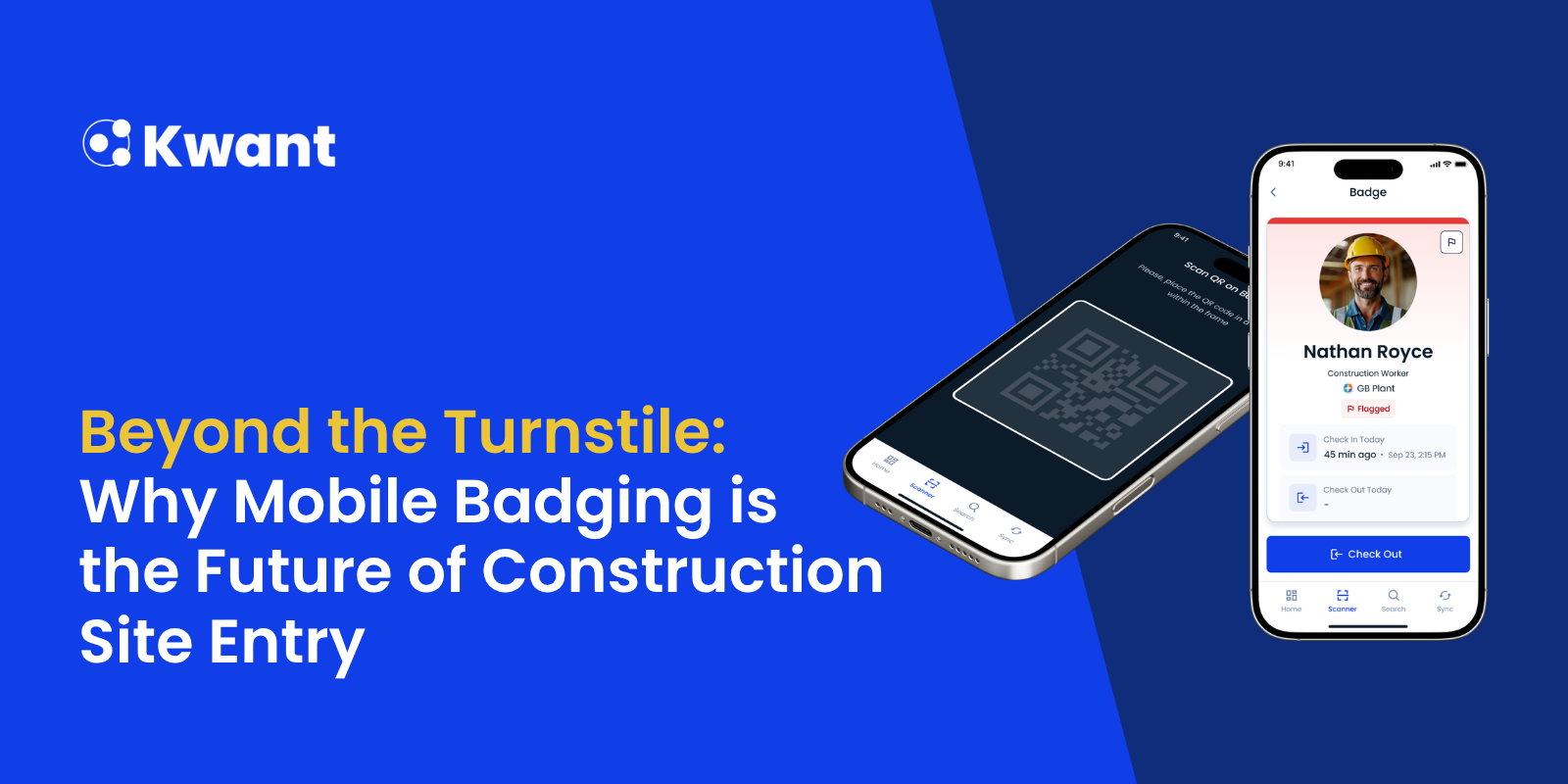
Access control shouldn't end at the gate. With a mobile app, your foremen can perform "spot checks" mid-site. In seconds, they can verify if a worker on a high-risk task has the necessary certifications (like an OSHA 30) digitally tethered to their profile. This is where contractor badge management becomes more than a gate function. It becomes a live compliance layer that follows the worker across the entire site footprint.
When a foreman scans a worker on-site, the app instantly returns one of three status signals that guide access and safety decisions:
- Green OK (Compliant & Cleared): Confirms the worker meets all safety and documentation requirements and is approved to enter the designated work zone.
- Needs Review (Action Required): Flags missing or expired requirements such as an overdue OSHA 30 certification, expired fall protection training, incomplete site-specific safety orientation, or a lapsed subcontractor insurance certificate, requiring supervisor review before work continues.
- Flagged (Escalation Required): Indicates a higher-level issue such as background check concerns or zone authorization gaps, requiring immediate escalation and restricted access until resolved.
This three-state system converts a passive gate log into an active compliance management layer. This turns your access system into a proactive safety tool rather than just a passive gatekeeper. It ensures that the contractor badge management record on your site reflects actual current certification status, not the status as of the last time someone checked a spreadsheet.
4. Real-Time Mustering and Visitor Management in Construction Site
In an emergency, you can’t rely on a turnstile log from three hours ago. You need to know who is standing at the muster point now. The Kwant mobile app allows for instant headcount, which means during evacuation events, safety teams can see in real time how many workers are confirmed out of each zone versus still showing as checked in. That distinction between a general headcount and a zone-specific confirmed-evacuation count is what makes the difference between a controlled evacuation and a dangerous uncertainty.
Furthermore, the Kwant mobile app simplifies visitor management for construction sites. The mobile app allows delivery drivers or one-day inspectors to receive temp passes that are scanned and logged instantly.
Temp passes are generated instantly within the platform, ensuring secure and trackable site access with no manual gaps:
- Automated Temp Pass Generation: Creates time-bound access passes tied to a specific entry window, ensuring controlled and temporary site access.
- Auto-Expiry for Security: Each pass expires automatically after the defined timeframe, eliminating the risk of unauthorized extended access.
- Real-Time Visitor Tracking: Every visitor record is time-stamped and linked to a specific zone, ensuring precise access monitoring.
- Unified Audit Trail: Temporary visitors are logged alongside permanent workforce entries, maintaining a single, consistent audit record.
- No Manual Logs Required: Eliminates paper sign-in sheets and manual entry errors, improving efficiency and compliance.
- Complete Access Visibility: Ensures there are no gaps in site access records, supporting full transparency and accountability.
This streamlined system enhances site security, simplifies compliance, and ensures accurate workforce and visitor tracking at all times.
Audit Trail That Makes Mobile Badging in Construction Beneficial
One legitimate concern about mobile badging for construction is accountability. If a supervisor's smartphone is the scanning device, how do you know that the access record is trustworthy?
Kwant’s architecture ensures complete accountability by attaching every scan event to five verified data points:
- Verified Operator Identity: Every scan is linked to the individual who performed it, ensuring full user accountability.
- Device-Level Traceability: The exact device used for the scan is recorded, preventing untracked or unauthorized entries.
- Project Attribution: Each scan is tied to a specific project, eliminating cross-project data errors or misreporting.
- Zone-Based Tracking: The system logs the precise zone where the scan occurred, enabling accurate location-based access control.
- Exact Timestamp Logging: Every action is recorded with a precise timestamp, creating a reliable chronological record.
This structured data model ensures that no scan is anonymous, no record is misattributed, and every access event maintains a complete, verifiable chain of custody from entry to audit.
For compliance audits, insurance reviews, or incident investigations, this level of attribution is the difference between a verifiable record and a contested log. For GCs operating on projects where ISO 27001 documentation, SOC 2 evidence packages, or OSHA recordkeeping are part of the owner's handover requirements, a complete and unambiguous audit trail is not a nice-to-have. It is a contractual obligation.
Where Mobile Badging Makes the Biggest Difference by Construction Site Type
- Data Center and Mission Critical Site: On mission-critical data center campuses where daily headcounts can reach 4,000 to 5,000 workers across multiple concurrent structures, mobile badging provides the perimeter flexibility and zone-level compliance verification that fixed turnstile systems cannot cover at scale. Workers bused in from remote staging areas, security personnel at temporary access gates, and foremen verifying credentials in energized areas all operate beyond the reach of a stationary gate scanner.
- Oil and Gas Construction: On oil and gas turnaround sites where specialized contractor rosters rotate on compressed schedules and certification verification is a safety-critical function, the mid-site spot check capability ensures only currently certified workers are operating in confined or energized spaces. A single uncertified worker in the wrong area on a turnaround site is not just a compliance gap. It is a stop-work event.
- Airport Construction: On airport construction projects where airside and landside access boundaries are defined by strict regulatory frameworks, mobile badge scanning at temporary access gates provides an auditable chain of custody for every contractor entering a controlled area. The TSA and FAA documentation requirements for construction activity in secured zones require the kind of time-stamped, identity-attributed record that a mobile-first system produces automatically.
- Multifamily Construction: On large multifamily developments where construction phases involve dozens of overlapping subcontractor crews, the visitor management function allows GCs to log owner visits, inspector walkthroughs, and material delivery drivers without maintaining a separate manual process. Every entry is captured in the same system as the permanent workforce record.
The Insight: Access Should Be "Hardware-Agnostic"
The "Higher Standard" of construction management means recognizing that your data is more important than your devices.
If you are still relying on "the word" of your subcontractors for worker headcount because your site is too small for a turnstile, or because your handheld scanner is sitting in a charging cradle in the trailer, you have a visibility gap.
By utilizing the Kwant Mobile App, you remove the friction of hardware. You get the flexibility to move from entrance to entrance, the redundancy to survive an outage, and the power to track every training and safety talk in the field—all without adding a single dollar to your hardware budget.
It’s Time to Go Mobile
Most providers sell you a scanner. At Kwant, the mobile app is one layer of a complete workforce management platform that saves teams an average of over 20 hours per week previously spent on manual headcounts, safety report preparation, and compliance reconciliation.
It’s time to move toward a more flexible, reliable, and "hardware-lite" approach to construction site access management. See how the Kwant Mobile App works across active construction sites, or request a demo to see it deployed against your specific site configuration.
FAQs
1. What is mobile badging for construction?
Mobile badging for construction is a smartphone-based system that allows security personnel, foremen, and supervisors to scan, verify, and log worker credentials at any point on a jobsite using a mobile app rather than a fixed handheld scanner or dedicated gate hardware. Every scan is time-stamped, zone-attributed, and tied to an individual worker identity, creating a continuous and auditable access record across the full site footprint.
2. How is mobile badging different from a standard handheld scanner?
A standard handheld scanner is dedicated hardware that performs one function at one location. It requires procurement lead time, a charging infrastructure, and replacement when lost or damaged. A mobile badging app turns any supervisor's smartphone into a full scanning and verification tool that works at the gate, mid-site, at a bus boarding point, or at a perimeter checkpoint. It also surfaces compliance status in real time, not just access permission.
3. What happens to scan data when there is no internet connection on site?
The Kwant app stores scan data locally on the device, encrypted, when connectivity is unavailable. When the connection is restored, the data automatically syncs to the platform in the background with no manual intervention. A manual sync option is also available. No scan data is lost and the access log remains continuous regardless of site connectivity conditions.
4. How does mobile badging support contractor badge management across multiple subcontractors?
Every worker in the Kwant platform carries a digital profile that includes their certifications, safety orientation status, insurance documentation, and zone authorization. When a foreman scans a worker mid-site, the app immediately surfaces whether that worker's credentials are current and whether they are authorized for that zone. Workers with expired certifications or incomplete safety requirements are flagged instantly, allowing supervisors to intervene before a compliance gap becomes a safety incident or an audit finding.
5. Can mobile badging be used for visitor management on a construction site?
Yes. Temporary passes for visitors including delivery drivers, owner representatives, and inspectors can be generated within the Kwant platform and scanned at entry using the mobile app. Each temp pass is tied to a specific access window, expires automatically, and is logged in the same audit trail as permanent workforce entries. There is no separate manual process required.
6. How does the mobile app support emergency mustering?
The Kwant app provides live checked-in and checked-out counts per zone, updated in real time as workers are scanned. During an evacuation, safety teams can view exactly how many workers are confirmed out of each zone versus still showing as checked in, enabling a zone-by-zone accountability check rather than a general site headcount. This removes reliance on turnstile logs that may be hours out of date.
7. Which construction project types benefit most from mobile badging?
Mobile badging delivers the most immediate value on projects where workforce density, multi-zone access control, or regulatory documentation requirements exceed what fixed hardware can manage alone. This includes hyperscale data center campuses with thousands of daily workers across multiple structures, oil and gas turnaround sites with rotating credentialed contractor rosters, airport construction projects with airside access documentation requirements, and large multifamily or commercial developments with high subcontractor turnover and overlapping trade schedules.
8. What should a GC or owner look for when evaluating a mobile badging solution?
Beyond basic QR scanning, the right solution should provide zone-level access attribution, real-time compliance status for each worker, an offline-capable architecture with automatic sync, a complete audit trail that attributes every scan to an operator, device, project, zone, and timestamp, and integration with project management platforms to eliminate manual labor reporting. The mobile app should function as one component of a broader workforce intelligence platform, not a standalone tool.
%20(1).svg)


