.svg)

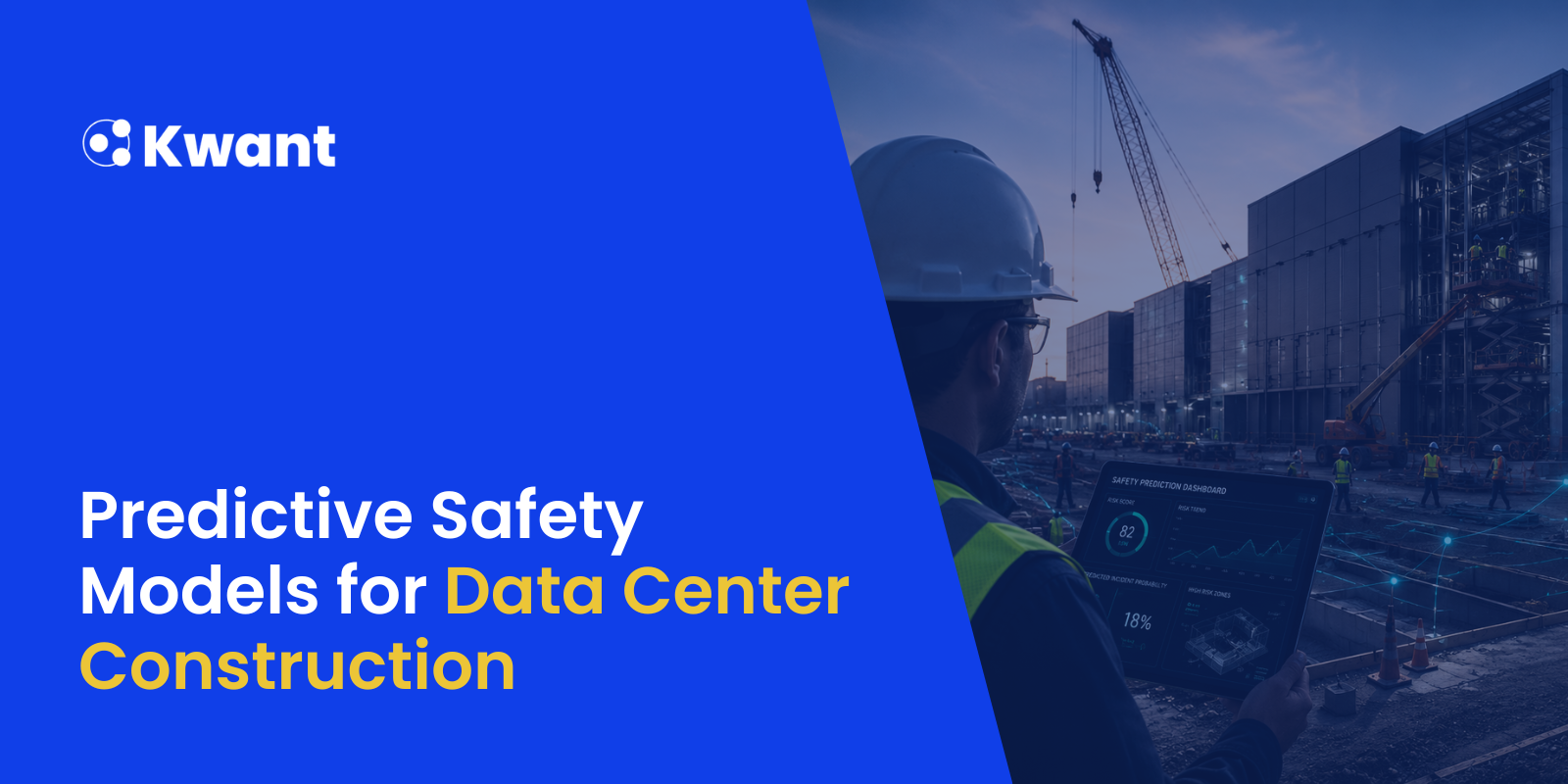


The incident report is the wrong place to start a safety investigation. By the time it is written, the harm has already happened, the contributing factors have already converged, and the window for prevention has already closed. The report is useful - it prevents recurrence, it satisfies regulatory requirements, it informs future training. But it is evidence of a failure, not a tool for preventing one.
Predictive safety is a different proposition.
It assumes that most incidents are not random events - that they are the product of identifiable conditions and behaviors that exist in the data
before the incident occurs. If you can see those conditions clearly enough, early enough, you can intervene before the harm happens. The injury becomes a near-miss. The near-miss becomes a corrective action. The corrective action becomes a better working environment.
On a data center construction site, this is not an aspirational framework. It is a practical operational requirement. Hyperscalers measure contractor safety performance across projects and factor it into contract awards. A single lost-time incident can trigger a full stoppage, a workforce audit, and a serious conversation about whether the GC can continue. The tolerance for 'we responded appropriately after the fact' is very low.
Why Safety Risk on Data Center Sites Has a Specific Profile
Data center construction creates a safety environment that is more demanding than most other construction verticals, for reasons that are structural rather than incidental.
The schedule compression is real. Hyperscalers and colocation operators are under constant demand pressure, and that pressure transmits directly into construction timelines. Compressed schedules increase the density and pace of work, reduce the tolerance for sequencing delays, and create the conditions under which safe work planning gets treated as an obstacle rather than a prerequisite.
The workforce density is high. A large data center campus under simultaneous construction can have multiple structures active at the same time, with MEP crews, structural crews, cabling and commissioning teams, and owner-supplied equipment installation teams all working in overlapping spaces. High workforce density in a confined space with complex MEP systems creates proximity hazards that are difficult to manage through periodic inspection alone.
The owner expectations are explicit. Most hyperscalers require contractors to maintain Total Recordable Incident Rate (TRIR) and Days Away, Restricted, or Transferred (DART) rates below published thresholds. Some require demonstration of proactive safety programs, not just acceptable lagging indicator scores. For GCs who want repeat work on these campuses, reactive safety management is a qualification risk.
The Gap Between Lagging Indicators and Actual Risk
TRIR and DART are useful metrics. They measure outcomes across a population over time, and they allow comparison between projects, contractors, and industry benchmarks. What they do not do is tell you where risk is elevated right now on your current site.
A site with a TRIR of 0.8 over the past twelve months may have an extremely high-risk condition developing in a specific work zone today. The lagging indicator doesn't see it. The weekly safety inspection may not be scheduled for that zone until Thursday. The foreman running the crew may be aware of the condition but managing it informally. None of these signals appears in the incident rate until the condition produces a recordable event.
Leading indicators are the alternative. Near-miss report frequency, toolbox talk attendance rates, PPE compliance observations, safety inspection scores by zone, and crew density in high-hazard areas are all signals that precede incidents in the data. They are harder to collect consistently and harder to aggregate meaningfully - which is exactly why most sites don't use them as primary management tools. But when they are collected consistently and analyzed well, they change the nature of safety management from response to prevention.
How Predictive Safety Models Are Built on Construction Sites
A predictive safety model is not a single algorithm. It is a system for connecting data inputs to risk assessments in a way that produces actionable outputs in time to act on them. The practical architecture has three components.
The first is consistent data collection. A predictive model is only as good as the leading indicator data that feeds it. If near-miss reporting is inconsistent - because there is a cultural disincentive to report, because the reporting form is cumbersome, or because foremen route around the system - the model will miss the signals that matter most. Data collection infrastructure has to come before data analysis.
The second component is risk scoring. Data from multiple leading indicator sources - inspection results, near-miss frequency, toolbox talk attendance, crew density maps, environmental sensor readings - is combined into a risk score for each zone and crew on the site. The score is updated continuously rather than on a reporting cycle. High scores generate alerts. Trends in scores over time reveal whether specific areas or contractors are improving or deteriorating.
The third component is intervention connection. A risk score that generates an alert is only useful if there is a clear protocol for what happens next. The alert needs an owner - typically the safety manager for the zone - with a defined response timeline. On the best-performing sites, elevated risk scores are reviewed as part of the daily pre-task planning process, so the intervention happens before work begins in the flagged area rather than in response to an event that has already occurred.
AI Safety Monitoring: What the Technology Does and What It Doesn't
AI-enabled safety monitoring on construction sites currently does two things well: pattern recognition across large data sets, and automated observation of physical conditions through computer vision. Both are useful. Neither replaces the safety judgment of an experienced professional.
Pattern recognition at scale means that the AI can identify correlations between leading indicator combinations and elevated incident risk that would be invisible to a human analyst reviewing the same data. When a specific combination of conditions - a new crew mobilizing in a zone with a recent inspection failure, during a high-heat day, on a compressed schedule phase - has historically preceded incidents, the model can flag that combination proactively even if no single leading indicator would trigger a manual review.
Computer vision for safety monitoring adds continuous observation capacity that human inspection cannot match. A camera-based PPE compliance system can monitor every worker in its field of view continuously, flagging violations in real time rather than catching them during periodic walkthroughs. Proximity detection systems can alert workers and supervisors when equipment and personnel are within unsafe distances, before contact rather than after.
What AI does not do is make safety decisions, manage safety culture, or replace the relationship between a safety manager and the workforce. The most effective predictive safety programs use AI to expand the data available to safety professionals - not to automate the judgment those professionals apply to that data.
What Leading Data Center Contractors Are Doing to Move Beyond Reactive Safety
The contractors with the strongest safety records on mission-critical builds have made two organizational commitments that are more important than any specific technology choice. First, they have made leading indicators a primary management metric - reviewed daily, tracked by trend, and used to direct safety management resources to where the data says risk is highest. Second, they have created a near-miss reporting culture where reporting is encouraged, protected, and visibly acted upon.
Both commitments require cultural infrastructure that technology supports but cannot create. A near-miss reporting system that is technically excellent but culturally punitive will under-report systematically, and the predictive model fed by that data will be unreliable. The technology investment is wasted without the cultural foundation.
The most forward-looking programs are beginning to connect safety data to workforce management data at the platform level - so that crew composition changes, new subcontractor mobilizations, and workforce density shifts are visible in the safety analytics environment alongside near-miss data and inspection scores. This integration is where predictive safety moves from sophisticated to genuinely operational.
Building Toward a Predictive Safety Program: What to Evaluate
- Data collection infrastructure before analytics investment. Near-miss reporting systems, digital inspection tools, and toolbox talk tracking platforms need to be in place and generating consistent data before a predictive model can be built on top of them. Evaluate your current data quality before evaluating analytics platforms.
- Integration between workforce management and safety systems. The most valuable predictive signals come from combining workforce data (crew composition, new mobilizations, density maps) with safety data (inspection scores, near-miss rates). Platforms that operate these as separate systems miss the most informative correlations.
- Alert ownership and response protocols. A risk score without a named owner and a defined response timeline is not a safety tool - it is a report. Evaluate how the platform assigns accountability for alerts and tracks response completion.
- Computer vision deployment feasibility. Camera-based safety monitoring requires site coverage planning, hardware installation, and connectivity that not all sites can support consistently. Evaluate what is achievable on your specific site before committing to camera-dependent features.
- Reporting alignment with owner requirements. Hyperscalers and large colocation operators have specific reporting formats for safety performance. Ensure any platform you evaluate can generate owner-required reports without manual reformatting.
The incident that doesn't happen is invisible in your metrics. There is no record of the intervention that prevented it, no line in the TRIR that it reduced. This is the fundamental accounting problem of preventive safety - its successes are silent. Only its failures appear in the data.
That invisibility can make predictive safety feel hard to justify to stakeholders who measure safety by incident counts. The argument has to be made differently: what is the cost of the incident that the reactive program would have caught only after it happened? On a data center build, where a single lost-time event can threaten a contract relationship, that cost is substantial.
The teams that have made this argument successfully, and acted on it, are the ones who show up to the next hyperscaler RFP with TRIR rates and a portfolio of proactive safety program documentation. Both matter. But the difference in safety culture is visible to owners who know what to look for.
See how Kwant's workforce management infrastructure supports predictive safety programs on mission-critical construction sites. Request a demo at kwant.ai.
Frequently Asked Questions
What is a predictive safety model in construction and how does it differ from a traditional safety program?
A predictive safety model uses leading indicator data - near-miss reports, inspection scores, workforce density, training completion rates - to forecast where and when incident risk is elevated, before an incident occurs. Traditional safety programs primarily analyze lagging indicators: TRIR, DART, recordable incidents. The difference is timing. Predictive models give safety teams the ability to intervene before harm occurs. Traditional programs primarily respond after harm has occurred, with the goal of preventing recurrence.
What leading indicators are most valuable for predicting safety incidents on data center construction sites?
The highest-value leading indicators on data center sites tend to be: near-miss report frequency and trend (a sharp increase often precedes incidents by days or weeks), safety inspection scores by zone (declining scores in a specific area are an early warning), PPE compliance rates in high-density work areas, toolbox talk attendance by contractor (low attendance correlates with lower safety engagement), and workforce density changes around the introduction of new crews or new subcontractors. Combinations of these indicators are more predictive than any single metric.
How does AI safety monitoring work on a construction site in practical terms?
In practical terms, AI safety monitoring on construction sites currently operates in two modes. The first is data pattern analysis - AI processes historical and real-time leading indicator data to identify combinations of conditions that correlate with elevated incident risk, generating risk scores and alerts. The second is computer vision - camera-based systems that continuously monitor for PPE compliance violations, unauthorized zone entry, and equipment-personnel proximity hazards. Both augment the capacity of safety professionals rather than replacing their judgment.
How does workforce management data connect to predictive safety analytics?
The most valuable predictive safety signals come from combining workforce management data with safety data. New crew mobilizations, subcontractor changes, workforce density increases in specific zones, and deviations from planned staffing are all workforce events that correlate with elevated safety risk. When workforce management and safety platforms share a data model, these correlations become visible and actionable. When they are separate systems, the correlation is invisible until after an incident connects the dots.
What is construction risk analytics and how is it used operationally?
Construction risk analytics is the practice of combining safety data from multiple sources - inspection results, near-miss reports, environmental sensor readings, workforce data - into risk scores and trend reports that safety managers use to prioritize interventions. Operationally, it is most effective when the outputs are embedded in existing workflows: reviewed in daily pre-task planning, referenced in weekly safety leadership meetings, and used to direct inspection resources to the highest-risk zones rather than on a fixed rotation schedule.
What should a GC evaluate when selecting a safety analytics platform for data center builds?
The evaluation should cover: data collection tooling (can the platform actually generate the leading indicator data a predictive model needs, or does it rely on manual input?), integration with workforce management (can it see workforce density and contractor changes?), alert ownership and response tracking (does it close the loop on alerts or just generate them?), owner reporting compatibility (can it produce the safety performance reports your hyperscaler clients require?), and evidence of deployment on projects with comparable workforce complexity.

%20(1).svg)


