.svg)

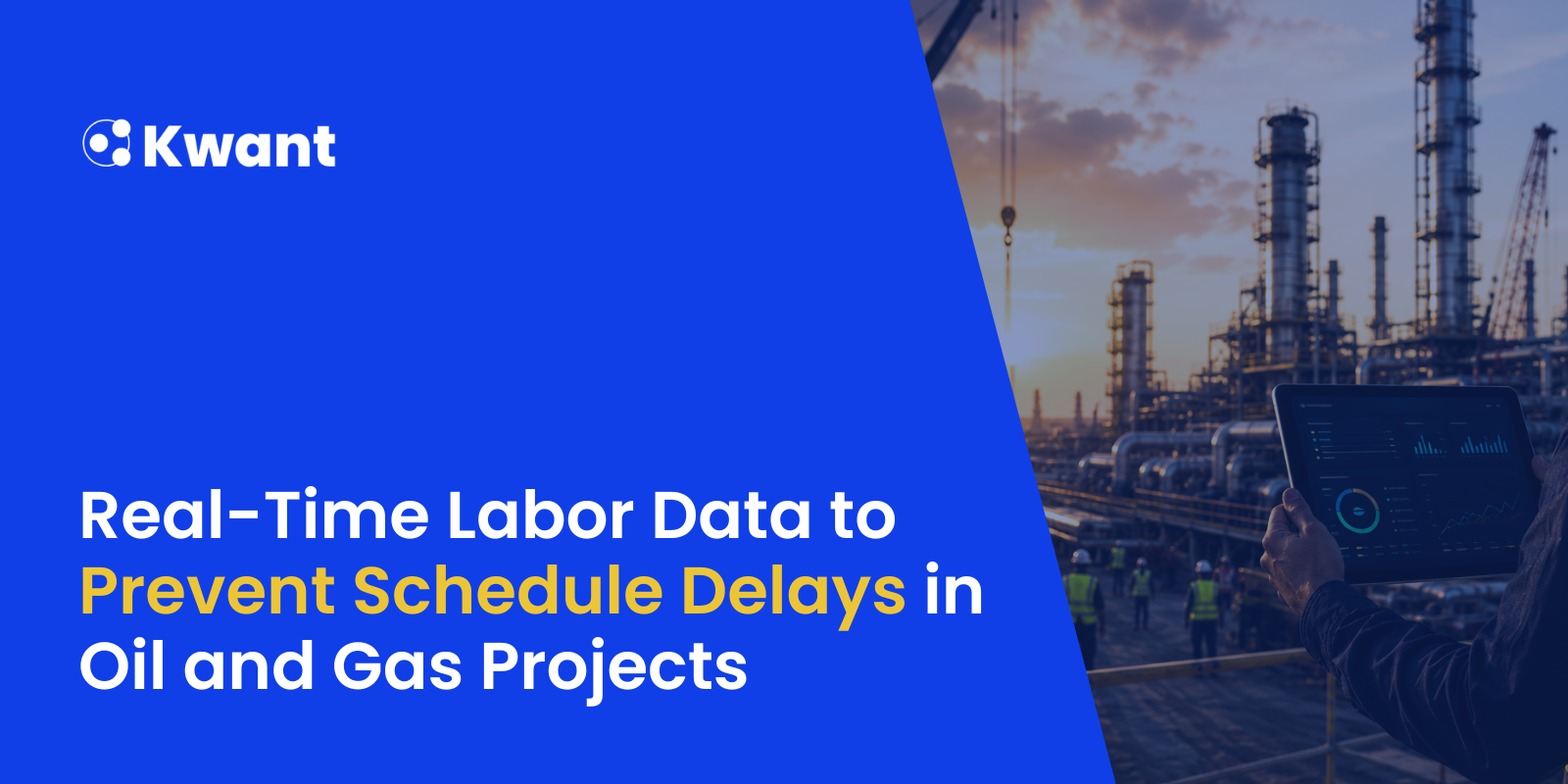


The cost report looked fine through week eight. Cost was tracking close to budget, the three-week lookahead showed no major conflicts, and the weekly meeting wrapped in forty minutes. By week twelve, the project was three weeks behind on the critical path, two subcontractors were in dispute over sequencing, and the owner was asking questions that required answers the project team didn't have ready.
This pattern repeats on oil and gas construction projects with a regularity that should prompt more systematic investigation than it typically receives. The schedule doesn't slip suddenly. It slips in increments - small crew shortfalls, minor productivity underperformance, sequencing deviations that each seem manageable in isolation. The common factor is that none of them were visible in the project controls system until the cumulative effect was already substantial.
Real-time labor data in Oil and Gas projects does not make projects easier to manage. It makes the problems visible earlier, when the response options are wider and the recovery cost is lower. That is a significant difference, but it is not magic. It requires systems, discipline, and a project controls culture willing to act on signals rather than waiting for confirmed problems.
Why Labor Data Is the Blind Spot in Oil and Gas Project Controls
Oil and gas project controls have a well-developed infrastructure for cost and schedule. Primavera P6 schedules are maintained with discipline on most large projects. Cost code tracking against budget is standard. Earned value analysis, while imperfect in its application, is common on EPC and LSTK contracts. The project controls team generally knows, within a reasonable margin, where cost and schedule stand.
Workforce productivity is the gap. The staffing plan - which specifies how many workers of each trade are required each day to support the scheduled progress - is used at bid time and at mobilization, then consulted infrequently unless a major disruption forces a replan. The daily reality of actual headcount versus planned headcount, actual hours worked versus productive hours, actual crew efficiency versus baseline assumptions: this data is collected informally, at best, in most project controls environments.
The gap between the staffing plan and actual workforce deployment is the mechanism through which most schedule delays accumulate. A crew that is 15% below plan for ten consecutive days has produced a two-day schedule impact in the affected work package. That impact is invisible in the weekly schedule update because the missed progress is attributed to productivity estimates rather than workforce gaps, and the investigation doesn't happen until the CPM critical path shifts.
By that point, the options have narrowed. Recovery requires acceleration, which requires more workers or more hours, which costs money and creates congestion. The project that looked manageable in week eight becomes expensive and stressful in week twelve. Nnot because anything catastrophic happened, but because a visible, trackable pattern was missed until it compounded.
What Real-Time Labor Data Actually Means in an Industrial Context
Real-time labor data in an oil and gas construction context is a continuous record of workforce activity: how many workers are on site, by trade and by contractor, compared to the plan for the same day. It also includes the activity-level detail that turns a headcount into a productivity signal: which work packages each crew is assigned to, when they entered and exited the site, and how that time distribution compares to the daily productivity targets embedded in the schedule.
This data comes from three primary sources that, when integrated, provide a picture that none of them can produce individually. Biometric access control systems provide timestamped gate-to-gate records for every worker. These insights are foundational data that determines who was on site, for how long, and by what sequence. Digital time-and-attendance systems extend this to task assignment - connecting the hours to specific work packages and cost codes. Field productivity reporting apps, used by foremen and area superintendents, provide the activity-level context that turns hours into meaningful productivity measurements.
The integration is the hard part. When these three data sources live in separate systems, the daily synthesis required to produce a meaningful labor performance report takes hours - which means it happens weekly at best. When they share a data model, the synthesis is automatic, and the labor performance picture is available every morning before the first crew enters the gate.
The Specific Ways Workforce Gaps Create Schedule Risk on Industrial Projects
Under-manning is the most common and most consistently underestimated driver of schedule delay on oil and gas builds. A subcontractor who committed to 80 piping welders in week 14 and delivered 65 has created a productivity gap of roughly 19%. Compounded over three weeks, that gap translates to a meaningful delay in the piping work package - which, depending on its position in the schedule, may or may not be on the critical path.
The critical path dimension is what makes workforce gap detection urgent rather than interesting. A work package that is behind but has schedule float is a management opportunity. The same work package at zero float is a schedule crisis. Real-time workforce data surfaces the under-manning pattern while the work package still has float - which is exactly the window when a productive conversation with the subcontractor about crew supplementation is possible.
Trade sequencing failures add another dimension. On an industrial site with complex interdependencies - structural completion before equipment setting, equipment setting before piping connections, piping connections before electrical and instrumentation - crew distribution errors can create idle time and rework that multiplies the original labor gap. When the piping crew is working in Zone B because the structural work in Zone A wasn't complete on schedule, both the piping scope in Zone B (which wasn't planned for that week) and the Zone A piping scope (which is now delayed) accumulate schedule impact simultaneously.
Predictive Workforce Management: What the Data Makes Possible
The transition from labor reporting to predictive workforce management happens when historical performance data is used to generate forward-looking forecasts rather than backward-looking summaries. On a project where several weeks of consistent labor data have been collected, patterns become visible that inform future planning in ways that the original estimate cannot.
Contractor-specific productivity rates - the actual relationship between committed headcount and delivered productivity for specific subcontractors on this project - are far more reliable forecasting inputs than industry averages from the bid estimate. If a particular structural contractor has been consistently delivering 88% of their committed crew for six weeks, a forecast that assumes 100% crew delivery from that contractor in the next phase is not a forecast - it is wishful thinking that will show up as a schedule variance in four weeks.
Scenario planning with real labor data changes the nature of schedule risk conversations at the program level. 'What is the schedule impact if craft availability in the specialty instrument trades drops 15% in Q4 due to regional competition?' is a question that can be answered quantitatively when the data model connects workforce inputs to schedule activities. The answer informs contingency planning, helps prioritize critical path activities for resource protection, and creates the basis for an honest conversation with the owner about risk.
What Leading Industrial Project Teams Track and Act On Daily
The project controls teams on the highest-performing oil and gas builds have a consistent morning ritual: reviewing the prior day's workforce data against the plan before the day's work begins. The review is not a summary report. It is a set of specific signals that require a response if they fall outside acceptable thresholds.
The signals that get daily attention are: the variance between actual headcount and planned headcount by trade (any variance above 10% triggers a same-day conversation with the responsible subcontractor), the gate-to-gate time distribution for crews in critical path work packages (extended non-productive patterns in these areas are a same-day investigation), and the zone-level crew distribution versus the week's area plan (misalignment between where crews are and where they should be, per the sequencing plan, is addressed before it creates idle time for following trades).
What these teams are not doing is waiting for the weekly schedule update to surface workforce performance trends. The weekly update confirms what the daily data already showed - it doesn't reveal new problems. When the daily data is the management tool and the weekly update is the confirmation, the recovery options are dramatically better.
Selecting Workforce Analytics Capabilities for Industrial Project Controls
- Bidirectional integration with Primavera P6. The workforce platform needs to both receive staffing plan data from the schedule (to enable plan vs. actual comparisons) and push actual labor performance back into the schedule environment (to keep the CPM current with real performance data, not estimates).
- Daily labor reporting at the work-package level. Program-level headcount summaries are useful for owner reporting. They are insufficient for project controls. The management tool needs to show labor performance by work package, by contractor, and by trade - the level at which schedule risk actually lives.
- Contractor performance benchmarking. The platform should allow comparison of headcount delivery against each contractor's commitment over time, producing a track record that informs future mobilization assumptions and provides objective evidence in subcontractor performance conversations.
- Pre-enrollment capability for turnaround surge events. Industrial turnarounds add hundreds of workers in days. The workforce platform needs to handle this volume without creating access bottlenecks - which requires digital pre-enrollment that completes the administrative processing before the worker arrives at the gate.
- Offline access control functionality. Industrial sites in remote locations or in areas with limited network coverage need access control that functions without continuous connectivity and syncs cleanly when connectivity is restored.
Oil and gas projects don't fail because project managers make bad decisions. They fail because project managers make decisions with incomplete information - because the workforce data that would have revealed the schedule risk was being collected manually, summarized weekly, and received three days after the events it described.
The investment required to close that information gap is not large relative to the cost of a three-week schedule overrun on a major industrial project. The barrier has been less about cost and more about organizational habits - the weekly report has been the baseline expectation for so long that daily workforce data management feels like a higher standard than necessary.
It is, until the schedule slips. At that point, the teams with daily data have options. The teams without it have explanations.
See how Kwant provides real-time labor data and workforce analytics for oil and gas project controls teams. Request a demo at kwant.ai.
Frequently Asked Questions
What is real-time labor data in oil and gas construction and how is it different from standard project controls?
Real-time labor data is a continuously updated record of workforce activity like headcount by trade and contractor, time on site, task assignment, that is available the same day the activity occurs rather than through a weekly reporting cycle. Standard project controls systems (Primavera P6, EVM) track schedule and cost against plan, but they depend on labor performance inputs that are typically estimated or reported weekly. Real-time labor data replaces those estimated inputs with actual performance data, making the project controls model more accurate and more timely.
How does workforce analytics detect schedule risk before it appears in the CPM update?
Schedule risk in the CPM typically appears as a variance when an activity misses its planned completion date. The workforce data that preceded that miss - under-manning, crew efficiency below plan, trade sequencing errors - was visible for days or weeks before the CPM reflected it. Workforce analytics systems that track plan vs. actual daily, and flag deviations automatically, surface these leading indicators while schedule float still exists. The CPM update confirms what the workforce data already showed.
What labor metrics should oil and gas project managers review every day?
The daily metrics with the highest management value are: actual headcount vs. plan by trade and work package (any variance above 10% in a critical path area warrants same-day action), gate-to-gate time for crews in high-priority work packages (extended non-productive patterns indicate a productivity problem worth investigating), and crew distribution vs. the area plan (crews working outside their planned areas signal sequencing deviations that create idle time for following trades). These three daily signals cover the majority of the workforce conditions that precede schedule delay.
How does predictive workforce management differ from traditional workforce planning?
Traditional workforce planning is forward-looking but static - the staffing plan created at project kick-off is the reference point throughout the project. Predictive workforce management updates that reference point continuously with actual performance data. Contractor-specific productivity rates from the current project replace industry-average assumptions. Observed crew delivery patterns replace contractual commitment assumptions. The result is a forecast that reflects how this workforce is actually performing, which is a more reliable basis for schedule decision-making than a plan created before mobilization.
Can oil and gas workforce analytics integrate with ISNetworld and contractor compliance platforms?
Yes, with appropriate integration architecture. Workforce analytics platforms typically support data import from ISNetworld, PEC Premier, and similar contractor compliance platforms for company-level qualification data. For individual worker-level data - which is what the labor analytics model needs - the integration typically draws from the site access control system, the time-and-attendance platform, and the field reporting tool. Workforce analytics platforms that provide native integration with all three sources, rather than requiring separate integrations for each, produce more reliable and consistent data.
What is the industrial project performance analytics capability that program-level owners should expect from their GC?
At the program level, owners should expect their GC to provide: daily actual vs. planned headcount by major trade category, contractor headcount delivery performance against commitments, weekly trend analysis showing whether workforce productivity is improving or declining by work package, and proactive notification when workforce performance trends indicate schedule risk before the CPM reflects it. These are not sophisticated requests - they are the data outputs of a workforce management system that is functioning as a project management tool rather than just a compliance system. GCs who cannot provide this data are not managing their workforce to a standard that large industrial owners should accept.
%20(1).svg)


