.svg)

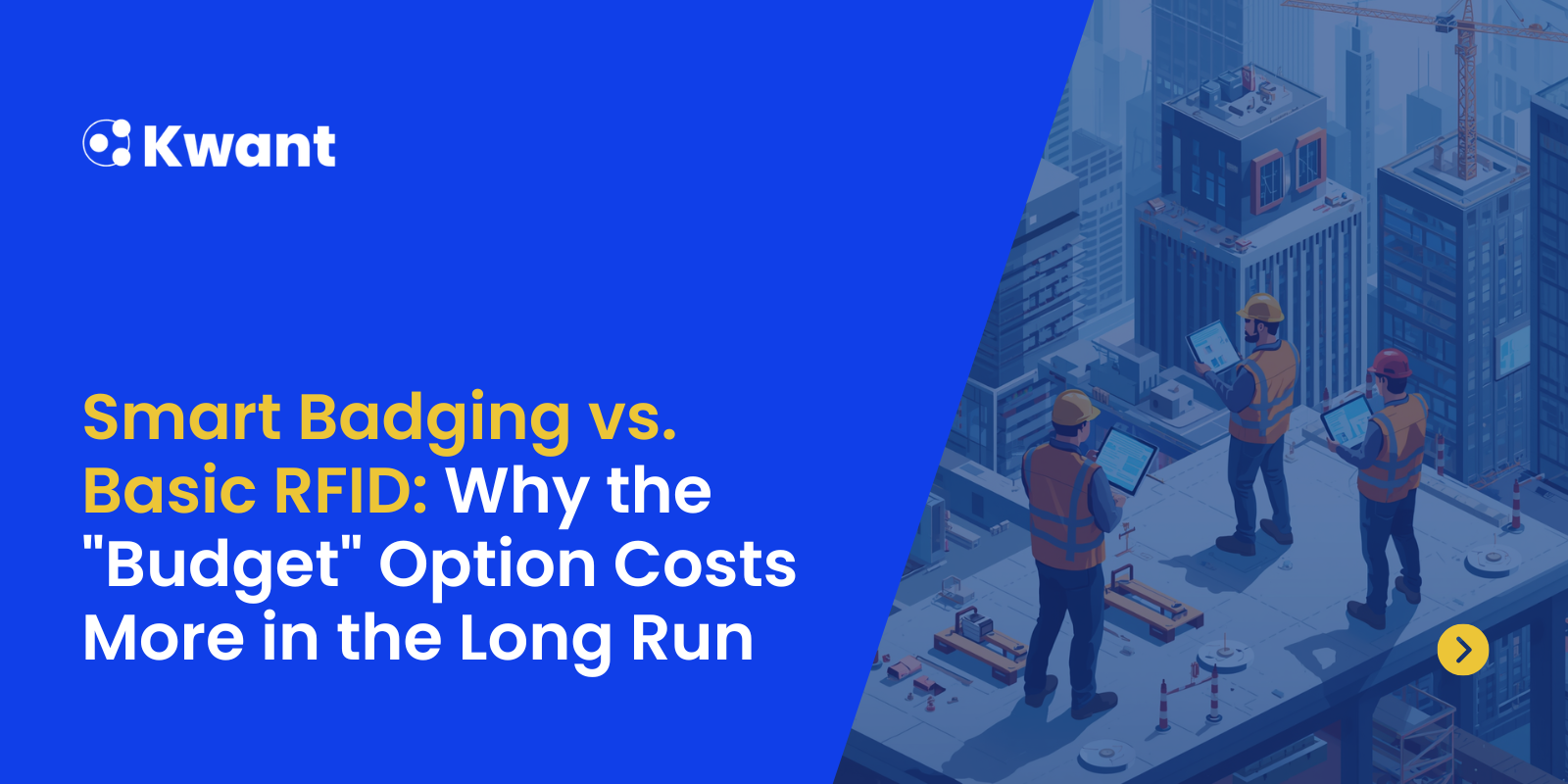


In the construction industry, we often default to the path of least resistance. When it comes to site access, that path is usually the basic RFID badge. It’s familiar, it’s inexpensive, and it satisfies basic insurance requirements.
But as we move through 2026, the gap between basic access and workforce intelligence has widened significantly. While a basic RFID card tells you a worker walked through a gate at 7:00 AM, it leaves you completely blind for the next eight hours.
If you aren't using smart badging, you aren't just saving a few dollars on hardware. It means you are missing out on the most powerful tools available for project control.
Moving Beyond Simple Entry
The primary reason companies stick with basic RFID is the perceived short-term cost savings. However, this often leads to a "penny wise, pound foolish" situation.
- The Reality: According to the AGC/Sage 2026 Outlook, over 80% of construction firms are struggling to find qualified workers. When labor is your most expensive and scarce resource, simply knowing someone arrived at the gate isn't enough to protect your margins. (Linked here is the sage blog)
- The Invisible Cost: A basic badge can’t detect "trade stacking," it can’t provide real-time mustering, and it can't tell you if a crew is spending 30% of their day walking across a massive campus to reach their assigned Zone.
The construction access control systems that leading GCs use in 2026 do not stop at the gate. They follow labor through every zone, building, and phase of the program.
The Smart Badge Advantage: BLE + RFID
A Kwant Smart Badge uses a combination of RFID (for traditional gate access) and Bluetooth Low Energy (BLE) for secure jobsite entry. This dual-technology approach unlocks data that a standard card simply cannot see.
The badge is ATEX-certified for hazardous environments and carries a battery life of up to three years, making it a practical fit for large-scale, long-duration programs including data center campuses, industrial plants, and airport construction. Depending on the deployment, badges can also include NFC or UHF configurations to integrate with existing access control infrastructure on site.
- Passive Labor Distribution: You don't need a turnstile at every internal door. The badge communicates with Kwant IoT Sensors to show you exactly how many electricians are in Building A vs. Building B without requiring any action from the worker.
- Safety & Fall Detection: Smart badges can be equipped to detect sudden impacts or "man-down" scenarios, sending an instant alert to the safety manager with the worker's exact location. On a large campus where management cannot be physically present across every floor and every building, this quick fall detection capability is the difference between a fast response and a delayed one.
- Productivity Heatmaps: Zone IQ visualizes where productive time is being spent versus where workers are idle or in transit. Management can visualize "slack time" vs. "work phase." If the heatmap shows a crowd idling near the hoist, you have a vertical logistics problem you can solve today, not next month.
Workforce Credential Tracking Built Into the Badge
One of the most significant operational gaps in basic RFID systems is the complete absence of workforce credential tracking. A standard RFID card confirms a worker's badge number. It tells you nothing about whether that worker's OSHA certification is current, whether their trade license is valid, or whether their employer's Certificate of Insurance has expired.
Kwant's smart badge system integrates directly with the platform's certification and compliance layer. When a worker badges in, the system cross-references their credentials in real time. If an OSHA card has expired or a required training has not been completed, the worker does not get cleared for access to restricted zones, regardless of whether they have a physical badge. The platform also sends automated expiration alerts to both the GC and the subcontractor before the issue reaches the gate, rather than after it creates a delay.
For mission-critical programs with strict security protocols, this layer of workforce credential tracking is not optional. It is the mechanism that keeps unqualified or uninsured workers out of controlled areas while keeping compliance documentation audit-ready at all times.
Access Control Without the Turnstile
The biggest challenge for our industry has always been the "open site"—projects where a turnstile isn't feasible. How do you get workers to wear a badge when there is no physical barrier to force the issue?
Kwant solves this through three flexible deployment options that can be mixed and matched across a single campus program:
- Option 1: Kwant Sensors: Our patented location sensors detect smart badges automatically. Even if a worker enters through a side gate, their presence is logged. No tapping, scans, or manual interaction required.
- Option 2: Hard Hat Tags: By moving the tech to the hard hat, the "badge" becomes part of the mandatory PPE. It’s visible and much harder to forget. This dramatically increases adoption on open sites where carrying a separate badge is easily forgotten, because no worker enters a job site without their hard hat.
- Option 3: Mobile App & Kiosks: For smaller sites, our mobile badge technology or Freestanding Tap-In Kiosks provide a cost-effective way to capture digital headcount without heavy infrastructure. Kwant Mobile App turns any smartphone into a gate scanner, delivering mobile badge technology. These kiosks can enable biometric access control for optional facial recognition.
The Secret Sauce: Simplifying the Field
Access control is quickly becoming a commodity. Kwant’s real value lies in what happens after the badge is scanned.
Kwant's intelligence layer converts raw badge and sensor data into operational tools. We don't just give you a list of names; we provide a tool that removes hours of manual work for your Superintendents and PMs.
- Automated Daily Reports: No more manual "man-counts" or clipboard math. Headcounts, trade distributions, and labor hours by zone are generated automatically by Kwant’s AI assistant, eliminating manual man-counts and clipboard tallies at end of shift.
- Zone IQ Analytics: Instant feedback on labor hours by floor, building, or safety area gives leadership a ground-truth view of productivity distribution across the site at any point in the day through real-time zone intelligence.
- Predictive Insights: AI analytics that flags when your "budgeted vs. actual" hours are trending toward a cost overrun, surfacing the variance while there is still time to correct it rather than after the budget impact has already occurred.
- Portfolio Analytics: For GCs managing multiple concurrent builds or projects, Portfolio Analytics collects workforce data across every structure simultaneously, replacing the fragmented reporting cycle with a single, real-time program view.
The Bottom Line: Is "Good Enough" Enough?
In the right scenario, a basic RFID badge and a simple turnstile setup might make sense for your site. But before you make a decision based strictly on the lowest bid, ask yourself what you might be leaving on the table : zone-level visibility, workforce credential tracking, fall detection, biometric access control, predictive labor insights, and the automated reporting that currently takes your team hours every week to produce manually.
Kwant is built to be the brain of your access strategy. Whether you use the basic badge option, turnstiles, mobile apps, or passive sensors, we turn raw entry data into a competitive advantage that helps you build faster and safer.
FAQs
1. What is the difference between smart badging and basic RFID in construction?
A basic RFID badge records entry and exit at a site gate. A smart badge combines RFID with BLE, LoRaWAN, and GPS to track a worker's location by zone throughout the entire site & entire shift. Smart badges also support fall detection, SOS alerts, and integration with credential tracking systems, capabilities that a proximity card cannot deliver regardless of the reader infrastructure attached to it.
2. Can smart badges work on open construction sites without turnstiles?
Yes. Kwant's location sensors detect smart badge presence passively throughout the site, meaning workers do not need to tap, scan, or pass through a physical barrier to be logged. Hard hat tag options integrate the technology into mandatory PPE & the Kwant Mobile App provides mobile badge technology for sites where neither sensors nor kiosks are yet deployed.
3. What is biometric access control in construction, and when is it required?
Biometric access control uses facial recognition to verify a worker's identity at the point of entry rather than relying on a badge that can be lost, shared, or transferred. On mission-critical projects such as data center campuses and secure government facilities, owners and GCs increasingly specify biometric verification to eliminate unauthorized access and buddy punching. Kwant's facial recognition system processes up to 6,000 face matches in under 0.3 seconds and logs attendance automatically at the moment of verification.
4. How does workforce credential tracking work with a smart badge system?
When a worker badges in, the platform cross-references their active credentials, including OSHA certifications, trade licenses and employer COI status, in real time. If a required certification has expired, the system can restrict that worker's access to controlled zones and simultaneously alert both GC and subcontractor. This removes the manual verification step that currently creates bottlenecks and compliance gaps on large sites.
5. What does mobile badge technology mean for construction sites?
Mobile badge technology turns a smartphone into a gate scanner using the Kwant Mobile App. Workers can check in digitally, and GCs can capture accurate headcounts and credential verification without deploying fixed hardware to every entry point. This is particularly useful for newly activated buildings on a campus program, smaller satellite sites, or locations where permanent sensor infrastructure has not yet been installed.
6. How do smart badges support safety on large construction sites?
Kwant smart badges include accelerometers that detect falls and sudden impacts. When an incident occurs, an instant alert is sent to the safety manager with the worker's identity, time, and exact location. This is critical on large campuses where management is spread across multiple buildings and cannot physically observe every work zone. Badges also support SOS button activation, allowing workers to manually trigger an alert when they need immediate assistance.
%20(1).svg)


