.svg)

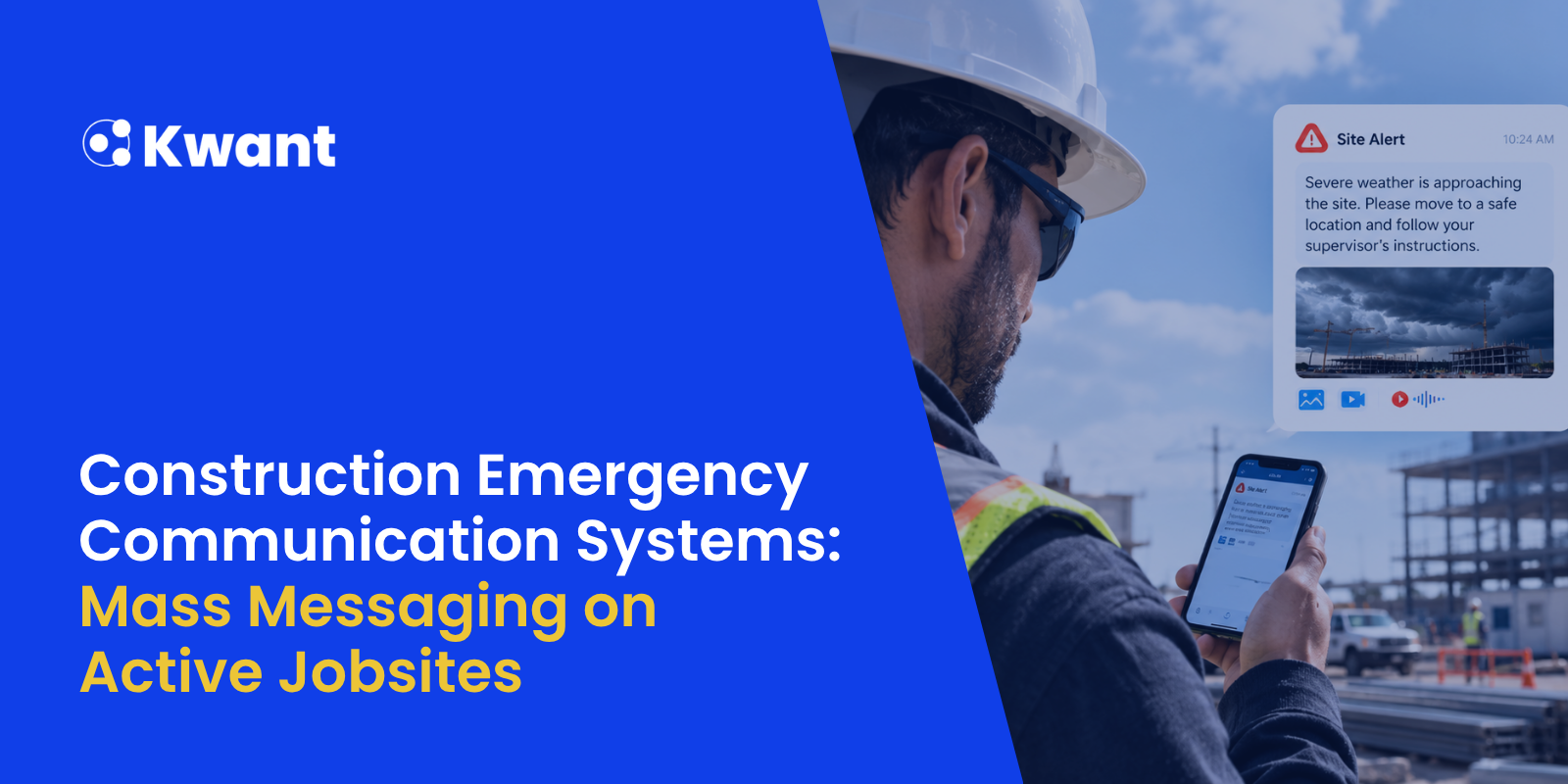


Quick Insights: Construction Emergency Communication Systems
- The core problem: Large jobsites have hundreds or thousands of workers across multiple contractors, buildings, floors, and work zones, making radios, supervisor call chains, emails, and static contact lists unreliable during fast-moving emergencies.
- What modern systems add: Real-time workforce visibility connects worker identity, contractor information, access status, and location or zone presence with emergency messaging.
- Targeted alerts matter: Teams can send evacuation, shelter-in-place, shutdown, weather, or hazard notifications to specific workers, contractors, shifts, roles, or work zones instead of disrupting the entire jobsite.
- Accountability goes beyond sending the message: A stronger system can track alert delivery and acknowledgments while helping safety teams determine who remains in an affected area and whether designated zones have been cleared.
- Multiple communication channels improve reach: SMS, mobile notifications, supervisor alerts, and other site communication tools can work together so critical instructions are not dependent on a single channel.
- Workforce data makes emergency response faster: Instead of calling supervisors and reconciling attendance records manually, incident teams can identify affected contractors, estimate exposed workers, and determine who needs escalation.
- AI adds an intelligence layer: Connected workforce data can help teams identify unusual activity, answer operational questions, summarize incidents, and surface accountability gaps without replacing human safety decisions.
- What to evaluate: Look for workforce visibility, location-aware targeting, contractor-wide communication, delivery and acknowledgment tracking, access-control integration, compliance records, and connections to broader safety and workforce management workflows.
Overview: Why Legacy Badge Management Breaks Down on Large Construction Sites
A worker is injured on the far side of a large construction site. A severe weather event is approaching. A safety issue requires an immediate shutdown of a specific area. A security concern needs every contractor informed within minutes.
The challenge is not knowing that communication matters. Every construction leader understands that. The challenge is reaching the right people quickly, confirming who received the message, and knowing who is still exposed to the risk.
Large construction projects are no longer simple job sites. They are dynamic environments with hundreds or thousands of workers, multiple contractors, changing site conditions, and constant movement between zones. Traditional communication methods like radios, emails, bulletin boards, and supervisor chains often break down when seconds matter.
A construction emergency communication system is becoming a critical part of modern jobsite operations because safety depends on more than sending a message. It depends on knowing who is on site, where they are working, and whether the information reaches the people who need it most.
Facts to Keep in Mind
According to the Bureau of Labor Statistics 2024 Census of Fatal Occupational Injuries, construction accounted for nearly one in five U.S. workplace fatalities that year, with 1,034 deaths recorded across the sector. Falls, struck-by incidents, electrocutions, and caught-in or between hazards together account for more than half of all construction fatalities annually under what OSHA identifies as the Fatal Four. These numbers reflect not only the physical risks of construction work but the operational gaps that allow hazardous conditions to persist longer than they should. Delays in emergency communication are one of those gaps.
Why Emergency Communication Is Different on Large Construction Projects
Construction sites operate differently from most workplaces. The workforce changes daily. Multiple subcontractors may operate under different safety processes. Workers may be spread across multiple buildings, floors, zones, or remote areas of a project.
For industries such as data centers, energy facilities, and large commercial developments, the communication challenge becomes even more complex.
A hyperscale data center project, for example, may involve thousands of workers moving through controlled areas while electrical, mechanical, structural, and commissioning teams work simultaneously. An oil and gas facility may cover hundreds of acres where workers operate in isolated zones with limited visibility from central operations teams.
In these environments, emergency communication cannot rely only on static contact lists.
A contractor may have completed onboarding weeks earlier, but their current location, shift assignment, or active work zone can change daily. A project executive may know the total workforce count, but that does not always answer the most important safety question: who is currently exposed to this risk?
Effective emergency communication requires a connection between messaging and workforce visibility.
Organizations already follow structured safety practices through frameworks such as OSHA 29 CFR 1926 requirements, site-specific safety plans, emergency action plans under OSHA 29 CFR 1926.35, and contractor management processes. These frameworks define how teams should prepare for emergencies, but execution depends on having accurate workforce information available when conditions change.
Without real-time visibility, even a well-designed emergency response plan can become a manual search process.
Safety teams may need to contact multiple supervisors, verify attendance records, and confirm worker locations before they understand the full situation. That delay creates unnecessary risk.
Where Construction Emergency Communication Systems Fit Within OSHA Requirements
OSHA 29 CFR 1926.35 requires employers on covered construction sites to establish and maintain an emergency action plan. The plan must address procedures for reporting emergencies, employee evacuation, accounting for all employees after evacuation, and assigned rescue duties. For multi-employer construction sites, OSHA 29 CFR 1926 Subpart C establishes that all employers share accountability for safety conditions affecting workers, regardless of which contractor employs them.
In practice, this means the communication obligation on a large construction site does not stop at the general contractor's own employees. Every subcontractor, specialty trade, and temporary worker present on an active project falls within the scope of emergency preparedness requirements. A communication system that only reaches a portion of the workforce leaves the general contractor exposed to a compliance gap that manual sign-in sheets and supervisor chains cannot reliably close.
Real-time workforce communication platforms address this compliance dimension directly. When alerts are delivered digitally with individual delivery confirmation and tied to verified workforce identity, the documentation needed to demonstrate that emergency communication requirements were met is generated automatically rather than reconstructed from memory after the fact.
The Cost of Poor Emergency Communication on Jobsites
When communication systems fail, the problem is rarely just a missed message. The impact spreads across safety, productivity, compliance, and project confidence.
One of the biggest challenges is incomplete workforce awareness.
Many projects still depend on sign-in sheets, badge scans without location context, spreadsheets, or supervisor reports to understand who is present. These methods can create gaps between the official workforce record and the reality happening in the field.
During an emergency, those gaps matter.
A few common breakdowns include:
Workers do not receive critical updates fast enough
A warning about severe weather, a hazardous condition, or a site closure may move through supervisors before reaching every contractor. Each communication step introduces delay. On a large project, a message that reaches one group quickly but another group much later creates inconsistent safety conditions.
Safety teams cannot confirm who is affected
Knowing that 2,000 workers are on site is useful. Knowing that 150 workers are currently inside the affected zone is far more valuable. Without real-time workforce data, teams may overestimate or underestimate the response needed. This affects evacuation coordination, accountability procedures, and post-incident reporting.
Contractors operate with disconnected communication processes
General contractors often manage dozens of subcontractors. Each company may have different supervisors, communication habits, and internal processes. A jobsite mass notification system must account for this reality by providing a shared communication layer across the entire workforce, not just employees of one company.
Compliance documentation becomes harder
After an incident, teams need accurate records: who was on site, when the alert was sent, who received it, what actions were taken, and how accountability was confirmed. Manual processes make this documentation difficult to reconstruct. Digital safety notification software can create a clearer record of emergency communication activities while supporting broader compliance workflows.
Research from the National Safety Council indicates that the average cost of a medically consulted workplace injury in construction reached $44,000 in 2023, not including indirect costs such as project delays, regulatory investigations, reputational exposure, and lost productivity. When delayed or incomplete emergency communication contributes to an incident that could have been contained, these costs are avoidable. A connected communication system is not a safety overhead. It is a risk reduction investment with measurable project-level consequences.
What the Right Approach Looks Like for Jobsite Mass Notification
A modern jobsite communication strategy is built around three connected capabilities: workforce visibility, targeted messaging, and verified response.
Emergency communication should not function as a standalone alert tool. It should connect directly to the operational reality of the site.
1. Start with accurate workforce visibility
Before sending an emergency message, teams need reliable information about the workforce.
This includes:
- Current worker count
- Contractor and employer information
- Active work zones
- Shift information
- Access status
- Training and credential status
A workforce management platform creates the foundation for better decision-making because leaders are not relying on yesterday's attendance records during today's emergency. Kwant's real-time location system provides continuous zone-level workforce presence without requiring manual check-ins, so the workforce picture available during an emergency reflects actual site conditions rather than scheduled assignments from earlier in the day.
2. Deliver alerts through multiple communication channels
Construction workers do not all interact with information the same way.
A complete construction emergency communication system should support multiple methods, including:
- Mobile notifications
- SMS messaging
- Supervisor alerts
- On-site communication systems
- Digital signage integrations where applicable
The goal is not simply sending more notifications. The goal is increasing the likelihood that the right people receive the right information quickly.
3. Target messages based on real conditions
Not every emergency requires a site-wide announcement. A localized hazard may only affect a specific building, floor, or work zone.
Targeted contractor emergency messaging allows teams to communicate more precisely:
- Electrical teams working in a restricted area
- Contractors assigned to a specific zone
- Workers requiring evacuation instructions
- Teams impacted by a schedule change
This reduces confusion and prevents unnecessary disruption across unaffected areas. Kwant's mass text alert platform supports location-zone-targeted delivery with individual confirmation, so a safety manager can send an evacuation notice to workers in the affected area without triggering a site-wide shutdown across unrelated scopes.
4. Confirm accountability after the alert
Sending an alert is only the first step. Leading teams also need visibility into what happens next:
- Was the message delivered?
- Did supervisors acknowledge the alert?
- Are workers accounted for?
- Has the affected area been cleared?
This moves emergency communication from a broadcast model to an accountability process.
The difference is significant. A broadcast tells people something happened. An intelligent communication system helps teams understand what happened and what needs to happen next.
What Automated Workforce Alerts Change During a Jobsite Emergency
The most effective emergency communication systems are not built around the message itself. They are built around the information behind the message.
A warning only becomes actionable when project leaders understand the workforce conditions connected to it.
For example, a storm warning affecting a 1,500-worker construction campus requires more than sending a weather alert. Safety teams need to know which crews are outdoors, which areas are exposed, which contractors are active, and whether workers have reached designated safe locations.
This is where workforce intelligence changes emergency response.
Instead of asking supervisors to manually determine who is impacted, teams can use real-time workforce data to make faster decisions. Kwant's deployment at a leading U.S. LNG terminal demonstrated this at scale: 7,500 workers across a 1,140-acre facility, where digital muster management and mass communication replaced manual roll calls that would have taken far longer during an active emergency. Workers who had not reached assembly points were identifiable in real time from the platform dashboard, removing the guesswork from accountability. Read the full LNG terminal case study to see how real-time workforce visibility performed at this scale.
Connecting Emergency Communication With Workforce Data
A modern site-wide communication platform should connect emergency messaging with the systems that already support daily construction operations.
The strongest approach combines the following capabilities.
Workforce identity: every worker should have a verified digital identity connected to their contractor, role, training status, and site access permissions.
Location awareness: teams need visibility into where workers are assigned or operating. This does not always require tracking every movement. In many cases, understanding zone-level presence provides the operational context needed for emergency response.
Access management: knowing who entered the site, when they entered, and whether they are authorized to be there helps teams maintain accurate accountability. Kwant's access control system connects gate-entry data to workforce identity records so the two stay synchronized throughout a project rather than drifting apart as crews rotate.
Communication history: emergency actions should create a documented record showing when messages were issued and how teams responded.
When these capabilities work together, safety leaders gain a clearer picture of the workforce during critical moments.
This same information also supports daily operations. The workforce data used during an emergency can help project teams understand productivity patterns, improve contractor coordination, and strengthen compliance processes.
From Mass Notification to Intelligent Response
Traditional jobsite alerts often operate as one-way communication. A message is sent. The team hopes it reaches everyone. That model does not match the complexity of modern construction.
A more advanced approach creates a feedback loop: Identify, Alert, Confirm, Analyze.
Identify: the system determines who is affected based on current workforce information. Instead of sending the same message to everyone, teams can define the impacted group.
Alert: workers and supervisors receive instructions through available communication channels. Messages can be adjusted based on the situation, whether the response requires evacuation, restricted access, shelter-in-place procedures, or operational changes.
Confirm: safety teams verify that communication reached the intended audience. Acknowledgment workflows provide additional confidence that critical instructions were understood.
Analyze: after the event, project teams can review communication records and response information to improve future emergency plans.
This creates a stronger safety cycle because every incident becomes an opportunity to improve readiness.
How Workforce Visibility Improves Construction Emergency Response
Emergency communication is often viewed as a safety function, but it is also an operational function. Large projects depend on coordination. When teams cannot quickly understand workforce conditions, every decision becomes slower.
Consider a major industrial construction site with multiple contractors working across several zones.
A safety manager receives a report of a hazardous condition in one area.
Without workforce visibility, the response may involve:
- Calling multiple supervisors
- Checking attendance records
- Confirming contractor rosters
- Walking the site to verify conditions
- Manually updating leadership teams
With connected workforce data, teams can immediately understand:
- Which contractors are active in the area
- How many workers are potentially affected
- Who has authorized access
- Which supervisors should receive escalation alerts
The difference is not just speed. It is decision quality.
On projects where Kwant has been deployed across multiple simultaneous sites, such as Resia's program covering 11,000 workers across 10 active construction projects, centralized workforce visibility meant that emergency accountability did not depend on each site running its own separate manual process. A single platform view gave leadership teams cross-site awareness that manual communication chains could not provide. See how this worked in the Resia case study.
The Role of AI in Construction Emergency Communication
Artificial intelligence is beginning to change how construction teams interpret workforce information.
The value of AI is not replacing safety professionals. It is helping them identify patterns and respond faster.
AI-powered workforce intelligence can support areas such as:
- Detecting unusual workforce activity
- Identifying gaps in accountability data
- Highlighting risk patterns
- Summarizing incident information
- Generating operational reports
For example, an AI assistant connected to workforce data can help leaders answer questions faster:
- How many workers are currently in this zone?
- Which contractors are affected by this restriction?
- What communication actions were taken during the incident?
- Which areas require additional follow-up?
Kwant's Bob AI assistant enables natural language querying of workforce data, so a safety manager can ask a question about zone occupancy or contractor presence during an active emergency without navigating a dashboard or pulling a manual report. This reduces the time spent searching for information and increases the time leaders can spend making decisions.
Platforms such as Kwant are designed around this broader workforce intelligence approach, connecting workforce identity, access management, safety workflows, and real-time operational data for complex construction environments.
What Leading Construction Teams Are Doing Differently
The most advanced construction organizations are moving away from isolated safety tools. They recognize that emergency communication, access control, compliance, and workforce management are connected parts of the same operational system.
Leading teams are building a single source of workforce truth.
This means moving beyond questions like "how many people are on site?" and toward more useful questions: "who is here, where are they working, what risks apply to them, and how do we communicate with them immediately?"
This shift matters because modern projects are becoming larger and more complex. Data centers, energy facilities, semiconductor plants, and infrastructure projects involve:
- Multiple contractors working simultaneously
- Strict safety requirements
- Tight schedules
- Complex access rules
- High operational consequences for delays
A disconnected approach cannot keep pace with that environment.
The strongest teams are using workforce data not only for compliance reporting but for active decision-making. They use the same information to improve:
- Emergency preparedness
- Contractor coordination
- Productivity tracking
- Workforce planning
- Site security
This is where workforce management evolves into workforce intelligence.
How to Evaluate a Construction Emergency Communication System
Selecting the right platform requires looking beyond basic messaging features. A system should support the way construction teams actually operate.
Key evaluation questions include the following.
Does it connect communication with workforce visibility?
A notification tool that does not understand site conditions creates another disconnected system. Look for platforms that connect alerts with worker identity, contractor information, and site activity.
Can messages be targeted?
A site-wide announcement is useful for major events, but many situations require precision. Ask whether the platform can communicate with specific groups based on location, contractor, role, shift, and access status.
Does it support contractor communication?
Large projects are built by multiple organizations working together. A strong contractor management system should support communication across the entire workforce, not only direct employees.
Can teams verify accountability?
Emergency communication should provide evidence of response. Evaluate whether the system tracks alert delivery, acknowledgment, response status, and communication history.
Does it support broader workforce operations?
The best systems provide value beyond emergencies. Consider whether the platform also supports digital onboarding, workforce compliance, access management, safety workflows, and productivity tracking construction teams rely on. Emergency communication should be part of a larger workforce operating model, not a standalone tool.
Does it integrate with existing construction workflows? Kwant integrates with Procore, Autodesk, and CMiC so that workforce data used for emergency communication connects to the project management systems teams already rely on for scheduling, compliance, and reporting.
A construction emergency communication system is no longer just about sending messages faster. The future of jobsite safety depends on connecting communication with accurate workforce visibility. Leaders need to know who is present, where work is happening, and how quickly teams can respond when conditions change.
The projects that perform best will be the ones where safety information moves as quickly as the workforce itself.
Real-time workforce alerts, intelligent communication workflows, and connected jobsite systems are becoming essential infrastructure for managing complex construction environments.
See How Workforce Intelligence Improves Jobsite Communication
Kwant helps construction leaders connect workforce visibility, safety processes, access management, and operational data into one workforce intelligence platform. See how modern teams are improving emergency readiness and jobsite control with connected workforce management. Request a demo to explore how Kwant's mass text alert and workforce visibility capabilities can support your next project.
Frequently Asked Questions
What is a construction emergency communication system?
A construction emergency communication system is a platform that helps project teams send, manage, and track critical safety messages across an active jobsite. Unlike traditional communication methods, modern systems can connect alerts with workforce data, contractor information, and site conditions. This allows teams to communicate more accurately during emergencies such as severe weather, safety incidents, or evacuation events. Under OSHA 29 CFR 1926.35, covered construction sites are required to maintain emergency action plans that account for all employees after an evacuation. A digital communication system that delivers confirmed alerts and generates documentation directly supports that requirement.
How is a jobsite mass notification system different from regular messaging tools?
A jobsite mass notification system is designed specifically for construction environments where workers, contractors, and locations change frequently. Regular messaging tools may send information broadly, but they typically do not understand who is on site, where workers are assigned, or whether communication reached the right people. Construction-focused systems combine messaging with workforce visibility and accountability. The ability to target messages by zone, contractor, or role and confirm delivery at the individual level is what separates purpose-built construction communication platforms from general messaging tools.
Can real-time workforce alerts improve construction safety compliance?
Yes. Real-time workforce alerts help safety teams communicate faster and maintain better records of emergency actions. When alerts are connected to workforce identity and access information, teams can better verify who received instructions and support post-incident documentation. This strengthens existing safety programs and emergency response processes. For multi-employer construction sites governed by OSHA 29 CFR 1926 Subpart C, digital communication records also provide evidence that the general contractor fulfilled its communication obligations across the full contractor workforce, not only its own employees.
Does a workforce visibility platform replace a contractor management system?
No. A workforce visibility platform and a contractor management system serve different but connected purposes. Contractor management focuses on managing qualifications, documentation, onboarding, and compliance requirements. Workforce visibility adds real-time operational context by showing who is active on the project and how teams are distributed across the site. Platforms like Kwant connect both layers, linking worker certification tracking and digital onboarding to real-time location and communication workflows so that the credential record and the operational picture stay in sync.
How do construction companies choose safety notification software?
Companies should evaluate safety notification software based on more than message delivery. Important factors include workforce integration, contractor support, location awareness, accountability tracking, and the ability to connect emergency communication with broader safety and productivity workflows. The right platform should support daily operations as well as emergency situations. Teams managing large contractor ecosystems should specifically evaluate whether the system can deliver targeted messages by zone or contractor group and confirm delivery at the individual level rather than relying on supervisor chains to cascade information.
Can AI be used for construction emergency communication?
AI can support emergency communication by helping teams analyze workforce data, identify potential risks, summarize operational information, and answer questions faster. AI works best when connected to accurate workforce data because better information leads to better decisions. The goal is not to automate safety decisions but to help leaders respond with greater speed and confidence. Kwant's Bob AI assistant enables teams to query live workforce data in natural language during active situations, reducing the time required to understand site conditions and identify which workers and zones need immediate attention.
What is the role of digital muster management in construction emergency response?
Digital muster management uses real-time workforce data to account for workers at designated assembly points during an evacuation or emergency. Rather than relying on manual roll calls or supervisor-reported headcounts, a digital muster system provides a live dashboard showing which workers have reached their assembly point and which remain unaccounted for in the affected area. This significantly reduces the time required to confirm full site accountability during a critical event. Kwant's smart wearables support automated muster tracking by continuously updating worker location data so that the muster report reflects actual positions rather than the last recorded gate entry.
%20(1).svg)


