.svg)

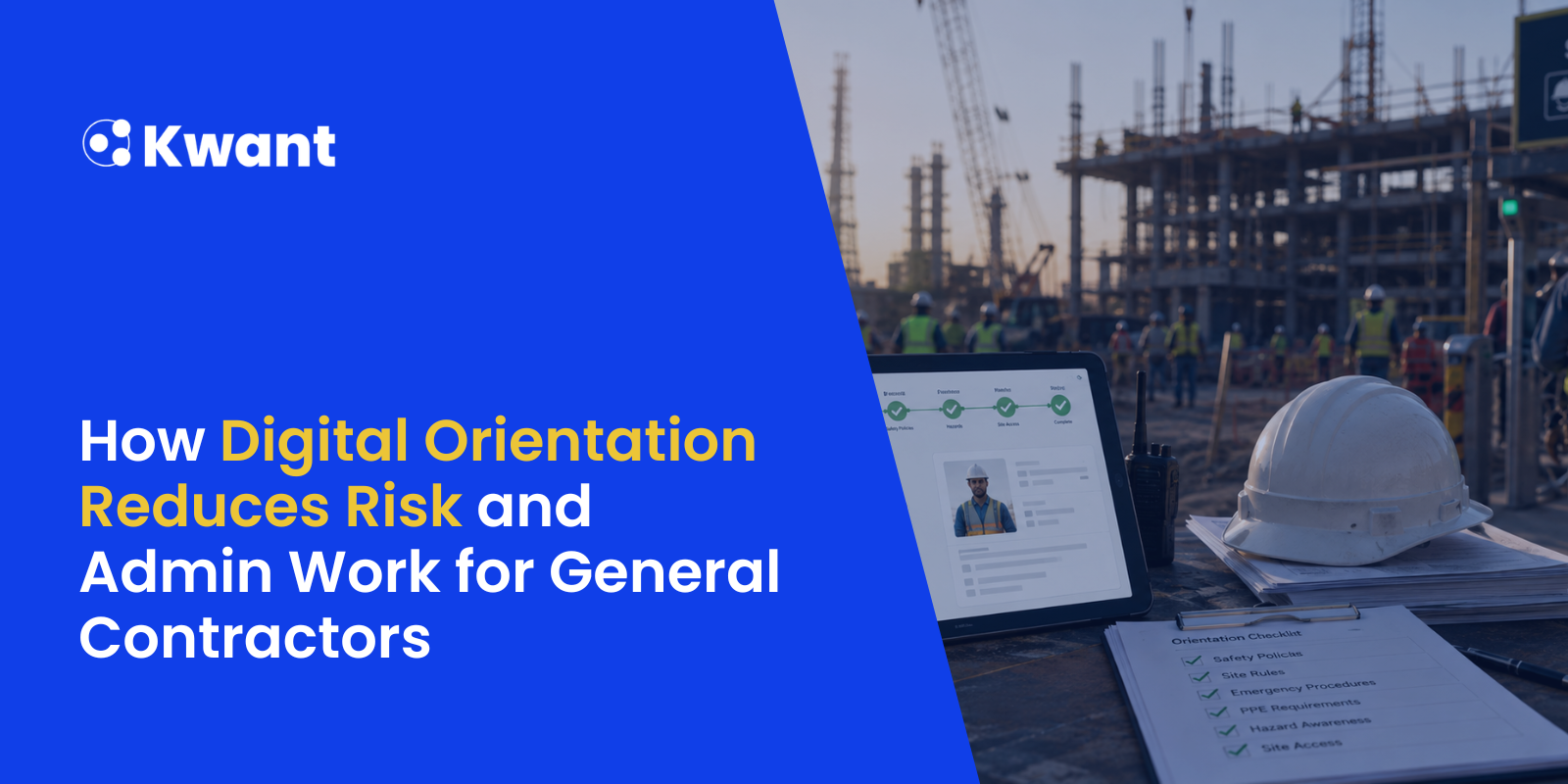


Construction onboarding becomes increasingly complex as projects grow and involve multiple subcontractors. Digital orientation streamlines worker onboarding by allowing employees to complete safety training, upload certifications, and verify compliance before arriving on site. This reduces administrative work, minimizes gate delays, improves workforce readiness, and helps general contractors maintain OSHA compliance. By combining automated training, certification tracking, contractor document management, access control integration, and real-time compliance dashboards, digital orientation creates a safer, more efficient onboarding process that scales across projects of any size while reducing risk and improving productivity.
Orientation Process in Construction Projects for General Contractors
Every construction project starts with the same question: Is this worker ready to be on site?
Answering that question sounds simple until hundreds, or even thousands, of workers from multiple subcontractors begin arriving throughout the week. Every individual needs to complete project-specific orientation, verify certifications, acknowledge safety procedures, and meet site access requirements before they can begin work.
For many general contractors, that process is still surprisingly manual. Orientation schedules are managed in spreadsheets. Training records are stored across different systems. Compliance documents arrive through email, text messages, or paper copies. Site teams spend hours checking paperwork instead of focusing on the jobsite itself.
The result is more than administrative frustration. Delays in onboarding create bottlenecks at the gate, increase the risk of compliance gaps, and make it harder to maintain a consistent safety culture across every contractor working on the project.
Digital orientation for general contractors changes that equation. Instead of treating onboarding as a collection of disconnected administrative tasks, it becomes a standardized workforce onboarding and safety orientation workflow that prepares workers before they ever arrive on site.
Why Construction Onboarding Is More Complex Than It Looks
Construction projects rarely have a stable workforce.
A single project may involve dozens of subcontractors, each bringing workers with different certifications, training histories, employer requirements, and project responsibilities. Large commercial developments, industrial facilities, and data centers often experience continuous workforce turnover as trades enter and leave throughout each phase of construction.
That creates several operational challenges.
Every worker must complete project-specific orientation before receiving site access. Safety teams must confirm that required documentation is current, verify mandatory training, and ensure workers understand site rules before they begin work.
The challenge becomes even greater when projects must comply with OSHA 29 CFR 1926 construction safety standards while also enforcing owner-specific safety policies, contractor agreements, and internal operating procedures. Missing documentation or expired credentials may prevent workers from accessing the site altogether. And in the event of an incident, the absence of verifiable orientation records creates significant compliance exposure.
Because these requirements constantly change as projects evolve, orientation is no longer a one-time event. It becomes an ongoing compliance process that follows workers throughout the life of the project.
Managing that process manually becomes increasingly difficult as project size grows.
The Cost of Getting Construction Onboarding Wrong
Poor onboarding rarely fails in dramatic ways.
Instead, small inefficiencies accumulate until they affect the entire project.
Workers arrive without completing required training. Supervisors spend valuable time resolving paperwork issues instead of managing field operations. Safety managers chase missing documents while access control teams manually verify credentials at the gate.
The consequences spread across several areas.
1. Delayed Productivity
When workers cannot access the site immediately, crews lose valuable production time. Even short delays can affect schedules when multiple subcontractors depend on one another to begin work.
2. Compliance Risks
Incomplete training records or expired certifications increase the likelihood of audit findings and make it more difficult to demonstrate workforce compliance if incidents occur. Under OSHA recordkeeping requirements, the burden of proof falls on the general contractor to demonstrate that orientation was completed; paper-based systems rarely hold up under inspection.
3. Administrative Burden
Safety professionals often spend hours each week tracking orientation completion, collecting signatures, updating spreadsheets, and answering repetitive questions from subcontractors.
4. Inconsistent Worker Experience
Different subcontractors frequently follow different onboarding processes, leading to confusion about site expectations and inconsistent communication across the workforce.
None of these problems are caused by a lack of commitment to safety. They happen because traditional onboarding processes were never designed to support today's scale of construction projects. As workforce sizes continue growing, manual orientation becomes increasingly difficult to sustain.
What Modern Digital Orientation for Construction Actually Changes
Digital onboarding construction platforms replace fragmented processes with a single workflow that guides workers from registration to site access.
Instead of requiring workers to complete paperwork after arriving on site, much of the process can happen before their first day.
A modern digital orientation process typically includes:
This approach improves more than convenience. It creates a consistent process that every contractor follows regardless of employer, trade, or project phase.
Workers know exactly what is required before arriving. Safety teams gain immediate visibility into outstanding requirements. Project managers can monitor workforce readiness without requesting updates from multiple departments.
Perhaps most importantly, digital orientation creates a continuously updated record of workforce compliance instead of a collection of disconnected files stored across different systems. That visibility becomes increasingly valuable as projects scale, workforce turnover accelerates, and owners demand greater accountability across every contractor working on site.
How Automated Training Strengthens Construction Workforce Compliance
Digital orientation is more than replacing paper forms with online versions. The real value comes from connecting training, compliance, and access control into a single workflow.
Instead of asking workers to complete orientation after they arrive on site, leading contractors shift much of the process upstream. Workers receive invitations before their first day, complete required training remotely, upload certifications, sign project-specific acknowledgments, and verify their information before traveling to the jobsite.
When workers arrive, they are already prepared to begin work.
This changes how compliance is managed throughout the project.
Training Becomes Continuous
Construction projects evolve constantly. New hazards emerge, work areas change, and owner requirements can be updated as projects progress.
Digital orientation allows project teams to assign additional training whenever requirements change rather than waiting for scheduled safety meetings or relying on paper sign-off sheets.
For example, if a new high-risk work zone opens, only workers authorized to enter that area can be assigned the necessary orientation before access is granted.
Documentation Stays Current
One of the biggest challenges for safety teams is ensuring certifications remain valid throughout the duration of a project.
A worker's OSHA card, equipment qualification, or employer-required certification may expire while they're actively working on site.
With automated construction worker certificate traking technology, credentials are monitored automatically. Teams can receive notifications before credentials expire, helping avoid last-minute access issues or compliance gaps or the discovery of lapsed qualifications during an audit.
For projects involving multiple subcontractors, COI (Certificate of Insurance) management adds another layer: verifying that every contractor's insurance documentation is current before crews mobilize, not after problems arise.
Site Access Reflects Worker Readiness
Perhaps the most valuable improvement is that orientation no longer exists as a separate administrative process. Instead, orientation becomes directly connected to site access control.
Workers who have completed all required steps can receive access immediately. Those with missing documentation, incomplete training, or expired certifications can be identified before they reach the gate, reducing delays for everyone else.
This creates a much cleaner relationship between workforce compliance and daily operations.Instead of verifying paperwork manually every morning, site teams can focus on managing construction activities.
What Leading General Contractors Are Doing Differently
The most sophisticated contractors no longer think about onboarding as a one-day event. They treat workforce readiness as a continuous operational process.
That shift has changed several aspects of construction project management.
First, orientation begins before workers ever arrive on site. Pre-arrival registration reduces congestion during mobilization and allows projects to scale more efficiently as workforce numbers increase.
Second, compliance information is centralized rather than scattered across emails, spreadsheets, and filing cabinets. Safety teams gain a real-time view of workforce readiness instead of assembling reports manually.
Third, project owners increasingly expect greater transparency into workforce compliance. Digital systems make it easier to demonstrate that every worker completed required orientation, maintained current certifications, and met project-specific safety requirements.
One example at scale: Kwant helped Resia manage 11,000 workers across 10 simultaneous construction sites in real time. A volume that would be impossible to manage through manual onboarding and spreadsheet tracking. Read the Resia case study
This visibility also creates better operational intelligence. When workforce data is centralized, project teams can answer questions that were previously difficult to track:
- How many workers are fully cleared to begin work tomorrow?
- Which subcontractors have outstanding onboarding requirements?
- Where are compliance bottlenecks slowing mobilization?
- Which certifications are approaching expiration?
- How long does onboarding actually take from registration to site access?
These insights allow contractors to improve planning instead of reacting to problems after they occur. As artificial intelligence and workforce analytics continue to mature, onboarding data becomes even more valuable. Historical trends can identify recurring delays, predict workforce readiness, and help project teams allocate resources more effectively across multiple jobsites.
Digital orientation is no longer just about replacing paperwork. It becomes part of a broader workforce operating system that connects onboarding, compliance, access, and analytics into a single operational view.
What to Look for in a Digital Onboarding Technology
Not every digital onboarding platform delivers the same operational value. When evaluating solutions, general contractors should look beyond online forms and consider how the platform supports the entire workforce lifecycle.
A strong solution should include:
1. Flexible Digital Orientation
Workers should be able to complete orientation before arriving on site using any device, reducing congestion during onboarding and improving the first-day experience.
2. Automated Compliance Tracking
The platform should monitor certifications, licenses, training records, and project-specific requirements automatically, giving safety teams visibility into workforce readiness at any time. This includes expiry alerts for OSHA cards, equipment qualifications, and employer-required credentials.
3. COI and Contractor Document Management
Beyond individual worker credentials, the platform should verify that subcontractor companies have current insurance documentation and project agreements on file before their crews mobilize.
4. Access Control Integration
Orientation should directly influence site access. Workers who complete requirements should receive access immediately, while incomplete requirements should prevent unauthorized entry. Removing the need for manual gate verification entirely.
5. Real-Time Workforce Visibility
Project teams should be able to see who has completed onboarding, who is pending approval, and which subcontractors still have outstanding requirements. From a single dashboard rather than across separate systems.
6. Contractor Management at Scale
As projects grow, managing hundreds of subcontractor companies manually becomes increasingly difficult. Modern platforms should standardize onboarding across every contractor while allowing project-specific requirements where necessary.
7. Reporting and Audit Readiness
Compliance records should be easy to retrieve during owner reviews, internal audits, or regulatory inspections. Digital documentation provides a clear history of completed training, acknowledgments, and certifications without searching through paper files.
Choosing the right platform is not simply about reducing administrative work. It's about creating a repeatable process that supports safety, productivity, and compliance from the first worker on site to the last.
Construction projects continue to grow in size, complexity, and workforce diversity. The onboarding process that worked for a 100-person jobsite simply doesn't scale to projects involving thousands of workers across multiple contractors and phases.
Digital orientation provides the structure needed to keep those projects moving. It reduces administrative burden, strengthens workforce compliance, and gives project teams greater confidence that every worker entering the site has completed the requirements necessary to work safely.
The most successful contractors are not replacing safety professionals with technology. They're giving those professionals better tools to focus on what matters most: protecting people, maintaining compliance, and keeping projects on schedule.
See How Digital Orientation Simplifies Workforce Management
Digital orientation is one part of a connected workforce management strategy. Platforms like Kwant help general contractors streamline safety orientation and worker onboarding, automate compliance tracking, and connect worker readiness directly to site access and workforce visibility.
If you're looking to modernize your onboarding process while reducing administrative work, request a demo to see how a digital-first approach can improve safety, compliance, and operational efficiency across every project.
FAQs on Digital Orientation & Onboarding for Construction
1. What is digital orientation for general contractors?
Digital orientation for general contractors is the process of completing worker onboarding, safety training, compliance verification, and required documentation electronically before workers arrive on site. Instead of relying on paper forms and manual checklists, digital platforms centralize training, certifications, acknowledgments, and approvals into a single safety orientation workflow. This reduces delays while improving consistency across every contractor working on the project.
2. How does construction worker onboarding technology improve safety?
Construction worker onboarding technology ensures workers complete required orientation and safety training before receiving site access. It also keeps certifications through automated certification tracking, assigns project-specific training when conditions change, and creates a verifiable record of compliance that holds up during audits and incident investigations under OSHA 29 CFR 1926 requirements. This reduces the likelihood of unauthorized access or workers beginning tasks without meeting project requirements.
3. Can digital onboarding help reduce administrative work in construction?
Yes. One of the biggest advantages of digital onboarding construction platforms is eliminating repetitive manual tasks. Safety managers spend less time collecting paperwork, updating spreadsheets, scheduling orientations, and tracking expired certifications. Automated alerts flag expiring credentials before they lapse, and compliance dashboards give safety teams a real-time view of workforce readiness without pulling reports manually. That time adds up quickly across a multi-project portfolio.
4. How does digital orientation support workforce compliance for GCs?
Digital orientation creates a centralized record of training, certifications, signed acknowledgments, and compliance documentation for every worker. This includes individual credential tracking through worker certification management and contractor-level insurance verification through COI tracking. Together, these tools make it straightforward for general contractors to demonstrate full workforce compliance during owner reviews, regulatory inspections, or post-incident investigations.
5. What should general contractors look for in a digital onboarding platform?
General contractors should evaluate platforms based on their ability to automate training, monitor certifications, integrate with access control systems, provide real-time workforce visibility, and generate audit-ready compliance records. The goal is not simply to digitize paperwork but to create a connected workforce management process, part of a broader workforce operating system , that scales with project complexity.
6. Is digital orientation only valuable on large construction projects?
No. While the benefits become even more significant on large commercial, industrial, and infrastructure projects, such as the Resia program where Kwant managed 11,000 workers across 10 simultaneous sites,digital orientation can improve efficiency on projects of any size. Standardized onboarding reduces errors, improves worker readiness, and creates a consistent process that grows alongside the contractor's operations.

%20(1).svg)


