.svg)



There's a version of workforce management that works on a single job. You know who's on site. Your safety team walks the floor. Your PM has a rough headcount. When something goes wrong, you find out about it, which is usually by the end of the day.
Then there's what enterprise construction actually looks like.
Multiple active projects across different regions. Thousands of workers from dozens of subcontractors cycling in and out. Compliance requirements that vary by contract, by trade, and by jurisdiction. Owners asking for documentation that lives in six different systems, none of which talk to each other. And program leadership trying to make real decisions based on reports that were assembled manually by someone who pulled the numbers last Thursday.
That gap between what leaders think they're seeing and what's actually happening across a program is where schedule risk hides. This is where compliance failures compound, and where the inability to compare performance across projects quietly costs money that never shows up cleanly on a ledger.
This is the operating environment that enterprise workforce management platform is built for. And the best ones don't just organize data. They make it usable - at scale, in real time, across your entire portfolio.
What "Enterprise" Actually Requires
Single-project workforce tools fail at the program level for a simple reason: they were never designed to answer the questions that program leadership actually needs answered.
A site superintendent needs to know who's on the floor right now. A project manager needs to know whether crews are in the right place at the right time. But a program manager, a project executive, or an owner's rep is asking something different entirely:
- How is workforce performance trending across all active projects?
- Where are we consistently falling behind the staffing plan?
- Are safety and supervisory compliance requirements being met, not just on paper, but in practice across every subcontractor on every site?
- If I need documentation for an audit next week, how long will it take to pull it together?
Enterprise workforce management means having infrastructure that answers all of those questions from the same data model, without requiring each project team to compile and translate their own records into something leadership can read.
Portfolio-Wide Visibility: The Foundation
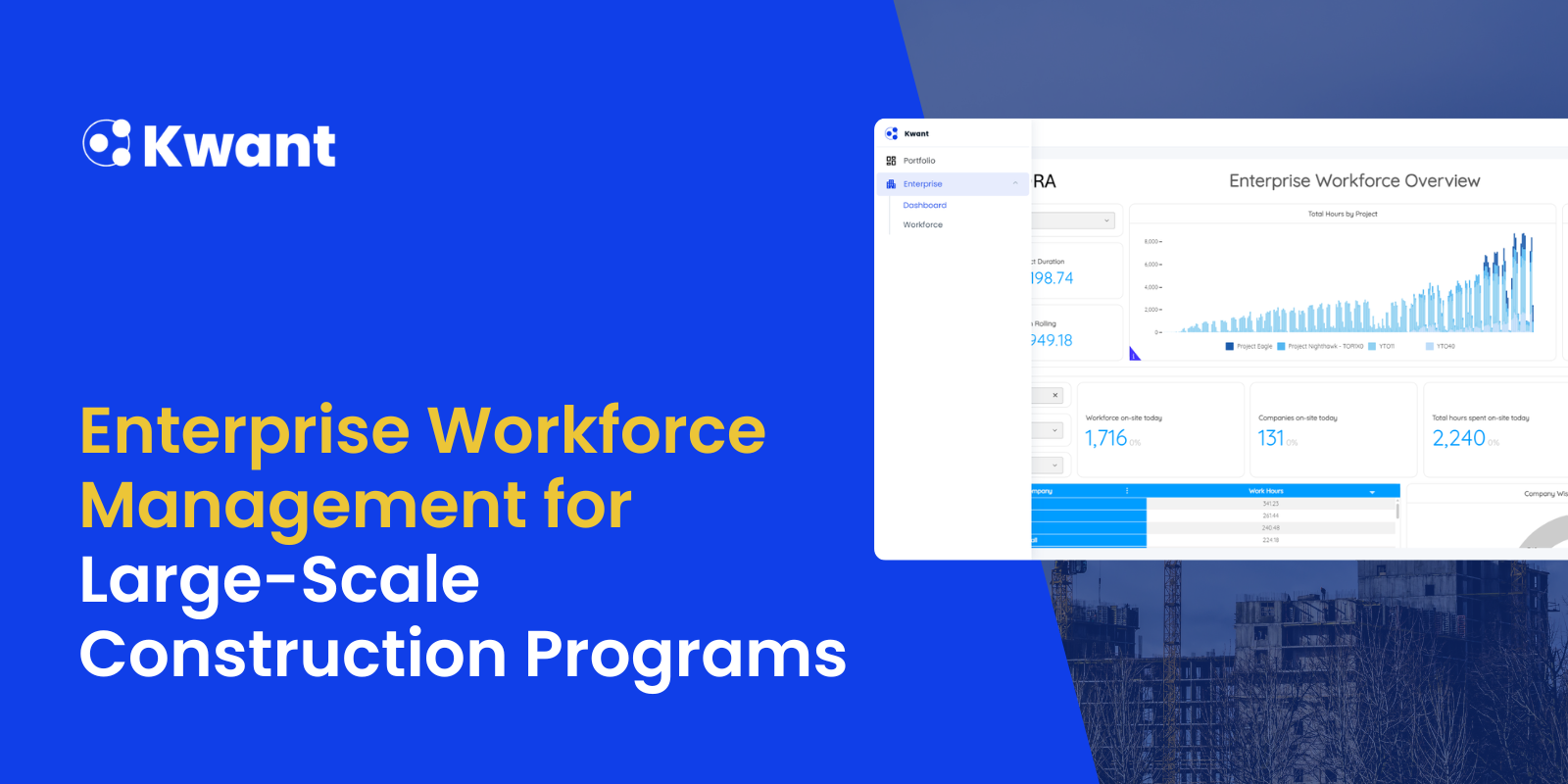
The first capability that separates enterprise platforms from project-level tools is portfolio-wide visibility. A live view of workforce headcount, labor trends, compliance status, and safety data across every active site, in one place.
This sounds simple. In practice, it's the hardest thing to do well.
Most programs today produce visibility through aggregation: each project team submits their data, someone at the program level collects it, normalizes it, and builds a summary. By the time it reaches leadership, it's already old. And because every project team uses slightly different processes, the data is rarely comparable.
Real portfolio visibility means the data is structured consistently from the start. It means a project executive can open a dashboard and see, without waiting for anyone to compile anything. How workforce deployment compares across five active projects that is broken down by trade, by zone, by subcontractor. It means anomalies surface automatically, before they're buried in a weekly report.
Kwant's enterprise dashboard gives owners, CMs, and GC leadership exactly this view. Program managers can compare workforce trends across a data center campus where multiple buildings are at different phases of construction, or track labor deployment across a multi-site industrial program with a single login. That kind of visibility used to require a dedicated analyst. Now it's available in real time to anyone with the right access.
AI-Assisted Reporting: When Time Is the Most Valuable Resource
One of the most consistent operational drains in large construction programs is reporting. Getting to the data isn't the hard part compared to interpreting it, formatting it, and making it accessible to the right people at the right time is.
Program leadership often finds out about workforce problems the same way they find out about everything else: from a call, from a report, from someone walking into their office. That's reactive by definition. And on a program where a two-day labor shortfall can cascade into a schedule delay, reactive is expensive.
AI-assisted reporting changes this. Ask Bob!, Kwant's AI assistant, it helps project teams and leadership query workforce data in plain language, without waiting for someone to pull a report. Who was on site yesterday? Which subcontractors are falling behind their headcount commitments this week? How does today's manpower count compare to the same phase on the last similar project?
The speed matters. On large programs, decisions get made in morning meetings, during site walks, in the middle of conversations with owners. Having instant access to accurate data rather than a best guess changes the quality of those decisions.
High-Risk and Restricted Zone Alerts: Managing the Complexity of Live Buildings
Large construction programs rarely have the luxury of building in a clean, isolated environment. Data centers turn over individual suites while other wings are still under construction. Hospital additions connect to active facilities. Industrial facilities bring new units online while commissioning others.
In these environments, managing who can access which areas, and knowing whether that access is being honored in real time is not just an operational concern. It's a safety and liability concern.
Kwant's ZoneIQ capability gives program teams the ability to define restricted zones with specific access rules and receive real-time alerts when those rules are broken. An owner's representative can see, live, which areas of a building have been turned over and whether any active construction personnel are in zones they shouldn't be. A safety manager can get an instant alert the moment someone without the right credentials enters a restricted commissioning area.
On a standard single-project deployment, this kind of zone management is valuable. On a large program where parts of the building are occupied or operational while others are under construction, it's essential.
Custom Dashboards: Because No Two Programs Are Same
Enterprise construction programs are not interchangeable. A $2B data center campus in the Mid-Atlantic has different workforce dynamics, different contractual requirements, and different executive reporting needs than a multi-site industrial turnaround in the Gulf Coast.
The right enterprise workforce platform recognizes this. Rather than forcing every program into the same reporting structure, it gives leadership the flexibility to configure dashboards that deliver the specific data they care about.
On Kwant, program managers and project executives can build workforce OS custom dashboard that surface exactly what matters on their program including headcount by trade against the staffing plan, compliance rates by subcontractor, zone-level productivity by phase, safety and supervisory ratios against contractual requirements. The platform provides the data model and the infrastructure; the team configures the lens.
This flexibility is the difference between a platform that gets used and one that gets abandoned after the first deployment.
Workforce History and Audit Archives: Compliance at Large-Scale Construction
Workforce compliance on a large program is a volume problem. Thousands of workers cycling through over the life of a project. Workers reassigned between sites. Subcontractors demobilizing from one project and mobilizing on another. Certifications expiring, credentials being renewed, safety orientations completed and documented.
Managing this manually, even with a well-organized project team, doesn't scale. And when an audit comes, the work of pulling documentation from every project individually and dealing with inconsistent formats, gaps in records, and files spread across multiple systems. These tasks can take weeks.
Leading general contractors using Kwant run portfolio-wide workforce documentation audits monthly. Every worker's compliance record, credential status, and certification history is available in one system, credential and certification management, that can search across the entire portfolio. What used to require hours of compilation from individual project teams can now be done in minutes that are standardized, complete, and audit-ready. An owner or CM can request documentation for any worker on any project without going through an intermediary.
The automation layer matters too. When a certification approaches expiration, the automated certification tracking system notifies the worker's employer, the site safety team, and the program compliance manager. If it lapses without renewal, access is suspended automatically through a automated access control system across all sites in the program. No manual intervention. No risk of a lapsed credential slipping through the gap between reporting cycles.
Activity Benchmarking: Turning Program Data Into Performance Intelligence
One of the most underutilized advantages of enterprise workforce management is the ability to benchmark performance across similar activities on different projects.
When data is siloed at the project level, every project is essentially solving problems in isolation. A GC might know that a particular concrete pour phase went over on labor .But, without a way to compare that against similar phases on other projects, they have no baseline for whether the variance was normal, a red flag, or an opportunity to improve.
Kwant's activity benchmarking gives program teams this cross-project comparison layer. An owner overseeing renovation work across multiple locations can compare how similar prep and installation activities have performed across different sites. The owner also needs to visualize the effect that activity start timing, preparation work, and average time spent in specific zones has on total completion time. Over time, these comparisons create a genuine performance baseline: what good looks like on this type of work, and where specific projects are falling short of that standard.
This is workforce intelligence in the real sense of the term. Not just data, but insight that changes how programs are run.
Explore AI Predictive Analytics for Productivity and Safety in Construction Jobsites
Safety and Supervisory Compliance: Enforced, Not Assumed
Contractual safety and supervisory requirements including ratios of safety staff to craft workers, requirements for supervisory presence during specific activities, certifications required for certain trades are typically verified reactively. Someone checks the sign-in sheets. Someone compiles a weekly report. An audit happens and discrepancies are discovered after the fact.
Kwant lets GCs and CMs bake contractual requirements directly into their dashboards. A contractor can configure the system to surface, first thing in the morning, which subcontractors are out of compliance with their safety staffing requirements across every project in their portfolio, in real time.
The shift from reactive audit to proactive monitoring is significant. Compliance issues that would previously surface in a weekly report or worse, during an owner audit are visible immediately. Subcontractors can be notified and corrective action can happen the same day, rather than after the fact.
Kwant Provides Construction Jobsite Onboarding and Digital Safety Orientation
Selecting the Right Platform for Your Program
Not every workforce management platform can operate at enterprise scale. The practical requirements are demanding:
- The platform needs to function offline when site connectivity is unreliable,
- Support multiple languages for a diverse craft workforce,
- Integrate with existing ERP and scheduling systems, and
- Give different levels of the organization the right access to the right data without creating security or privacy risks.
The evaluation questions that matter most at the enterprise level:
- Can the platform maintain consistent data standards across all sites in a program, while giving each site flexibility to configure its own access rules and compliance requirements?
- Does it support portfolio-level reporting that leadership can access directly, without waiting for project teams to compile and submit data?
- How does it handle workforce records when workers move between projects or when subcontractors partially demobilize and remobilize?
- Can it generate audit-ready documentation across the entire portfolio without manual compilation?
- Does it have the AI and analytics layer to turn workforce data into actionable insight—not just dashboards that sit unused?
These are the capabilities that separate enterprise workforce infrastructure from project-level tools that happen to be deployed at scale.
Kwant Mobile App for Live Worker Status: Onsite/Offline Visibility
The Competitive Advantage Is Already Being Built
The general contractors and owners who are winning on large, complex programs are not doing it with better spreadsheets or more frequent check-in calls. They are doing it with better data that’s consistent, real-time, and comparable across every project in their portfolio.
Kwant is working with leading GCs, owners, CMs, and construction consultants on exactly this problem: building the operational infrastructure that makes large programs manageable, auditable, and continuously improving. The teams using enterprise workforce management effectively are not just running their current programs better. They are building the institutional knowledge. The benchmarks, the compliance records, the workforce intelligence which make every future program run more predictably.
That's the compounding value of getting this right. And the window to build that advantage is now.
Learn how Kwant supports enterprise workforce management at kwant.ai.
FAQs on Enterprise Workeforce Management for Large-scale Construction
What is enterprise workforce management in construction?
Enterprise workforce management in construction refers to the use of a unified digital platform to manage the workforce across multiple sites, contractors, and project phases. It encompasses contractor onboarding, credential management, site access control, productivity tracking, and compliance reporting, all accessible from a single system by stakeholders at different levels of the organization.
How does a contractor management system differ from an enterprise workforce platform?
A contractor management system typically focuses on the pre-qualification and document collection process at the company or subcontractor level. An enterprise workforce platform extends beyond that to manage individual workers in real time covering their access, their credentials, their presence on site, and their productivity contribution. On large programs, you need both capabilities in an integrated system.
Can one platform manage workforce compliance across multiple construction sites?
Yes. Modern enterprise workforce management platforms are designed specifically for multi-site deployment. They maintain a central database of worker credentials and access profiles, with site-specific rules applied locally. This means a worker enrolled once can be deployed to any site in the program, with compliance rules enforced automatically at each location.
What productivity metrics should large construction programs track?
The most important program-level metrics are labor utilization rate (actual hours on site vs. scheduled), manpower plan vs. actual by trade, crew efficiency by work package, gate-to-gate time, and credential compliance rate. These metrics, tracked in real time across all sites, give program managers the early warning signals they need to prevent schedule slippage.
How does jobsite access management integrate with compliance tracking?
In an integrated workforce platform, access management and compliance tracking are connected at the data level. A worker can only be granted access if all their required credentials are current and verified. If a credential lapses, access is automatically suspended across all sites. This integration eliminates the gap between what the compliance system shows and what is actually enforced at the gate.

.png)
%20(1).svg)


