.svg)



Data center construction pushes workforce management to a level most commercial projects never experience.
On a hyperscale campus, project teams may coordinate thousands of workers across multiple buildings, dozens of subcontractors, active security zones, and compressed commissioning schedules. All while satisfying strict owner requirements that go well beyond standard code compliance. Many hyperscalers and co-location operators layer on their own mandates: NDA enforcement, background check protocols, zone separation between contractor tiers, and audit documentation available on demand.
The challenge is no longer simply getting labor onto the jobsite.
It is getting the right workers, with the right credentials, into the right areas at the right time without slowing productivity or increasing administrative burden.
For project executives, construction managers, project controls teams, and safety leaders, workforce management has become far more than a back-office process. It directly impacts schedule certainty, site security, labor forecasting, and owner confidence. A missing certification can delay work. An access bottleneck at the gate can cost productive hours. Poor workforce visibility across trades can create schedule risk long before leadership realizes the project is drifting.
This is why leading contractors and owners are turning to secure construction workforce platforms like Kwant and not just to satisfy compliance requirements, but to gain the real-time workforce visibility that complex, mission-critical projects demand.
Why Data Center Construction Requires a Different Workforce Strategy
Building a data center is fundamentally different from building a commercial office tower, a warehouse, or a healthcare facility.
These projects sit at the intersection of construction, security, and critical infrastructure. Active IT equipment may be running in adjacent wings while crews work nearby. Multi-tier contractor networks mean a single campus might involve a general contractor, a dozen major subcontractors, and hundreds of craft workers from multiple firms. Where all needs different levels of access at different times, in different areas, across different project phases.
Compliance requirements reflect that complexity. Data center sites often require alignment with frameworks like NIST 800-53 and SOC 2 operational security standards, in addition to trade certifications, site-specific orientations, and background screening mandates. Every person on site must be verifiable at any moment.
At that scale, manual workforce tracking breaks down quickly. Spreadsheets, disconnected badging systems, manual credential checks, and daily headcount calls were never designed for the speed or complexity of mission-critical construction.
The result is fragmentation. One platform for onboarding. Another for gate access. Separate spreadsheets for certifications. Manual reporting for owners. Daily workforce counts completed by hand.
That fragmentation creates operational friction and on large data center campuses, friction is expensive.
The Hidden Cost of Disconnected Workforce Systems
Many teams underestimate how much time and risk live inside the gaps between their systems.
Safety teams spend hours reconciling certifications. Project managers struggle to understand actual labor deployment. Project controls teams lack reliable workforce data for forecasting. Owners have limited visibility into manpower trends across active projects.
These inefficiencies may seem manageable early in a project. But as campuses scale and contractor counts increase, small gaps become larger operational risks. Questions become harder to answer:
- Who is actually on site right now?
- Which contractors are understaffed compared to plan?
- Are required certifications current across all active trades?
- Which areas of the project are falling behind staffing targets?
- How does workforce deployment compare across buildings or campuses?
Without centralized workforce visibility, teams operate reactively. And on a mission-critical project with a compressed commissioning schedule, reactive is a dangerous way to manage labor.
What a Secure Construction Workforce Platform Actually Does
A secure construction workforce platform is a centralized system designed to manage the full lifecycle of construction labor from onboarding and credentialing through daily access management to final demobilization.
At its core, it connects three operational priorities that are typically managed in isolation:
Workforce Compliance: Ensuring workers meet required certifications, safety training, background checks, and owner-specific requirements before arriving on site. On a data center project, this might include OSHA 10/30 certifications, trade licenses, site-specific orientation completion, NDA acknowledgment, and security clearance status.
Jobsite Access Management: Controlling who can access which areas of a project based on role, credentials, shift schedule, or security requirements. Access rules are enforced automatically at entry points, not manually reviewed at the gate.
Workforce Visibility: Providing real-time insight into labor deployment, headcount by trade, zone utilization, and productivity trends that help project teams make faster, better decisions.
Rather than three disconnected systems, project teams get one source of truth where compliance status, access permissions, and workforce data are connected and continuously updated.
Here is how that compares to what most teams use today:
Compliance Without the Friction
One of the most persistent misconceptions in construction is that stronger compliance creates slower operations.
In reality, friction in compliance comes almost entirely from manual processes like paper forms, email chains, morning roster reviews, last-minute badge checks. When those steps are automated, compliance stops being a bottleneck and starts being a background function.
Consider what automated workforce compliance software actually changes on a data center project:
When a worker's OSHA certification approaches expiration, alerts go out automatically to the worker, their employer, and the site safety team. If the credential expires without renewal, access is placed on hold and the worker cannot badge in until it is verified. No one has to catch it during a 6:00 a.m. mobilization check.
When a new subcontractor is onboarding workers, incomplete requirements are flagged before those workers arrive at the gate, not after.
When a hyperscaler auditor requests documentation like who was on site on a specific date, what certifications were active, whether orientations were completed before access was granted. The platform generates those reports automatically. What once required days of spreadsheet work takes minutes, and the data is timestamped and verifiable.
Workers who are fully credentialed and pre-enrolled move through access checkpoints in seconds. The gate stops being a bottleneck. And project teams stop spending hours managing what the platform can handle automatically.
On large campuses where thousands of workers move through access points every day, those small reductions in friction compound quickly.
Productivity Visibility Is the Other Half of the Equation
Compliance keeps the wrong people off the jobsite. Productivity visibility tells you whether the right people are being deployed effectively.
These are two different problems and both matter on a data center project.
Historically, project teams relied on manual headcounts, superintendent reports, and subcontractor staffing updates to understand labor conditions. That worked until projects became larger, schedules became tighter, and workforce complexity increased.
Today, leading data center builders are using workforce data to understand whether labor deployment is actually supporting the project schedule. Not surveillance but operational clarity. The goal is not to micromanage field workers. It is to give construction managers and project controls teams the information they need to make faster, better decisions.
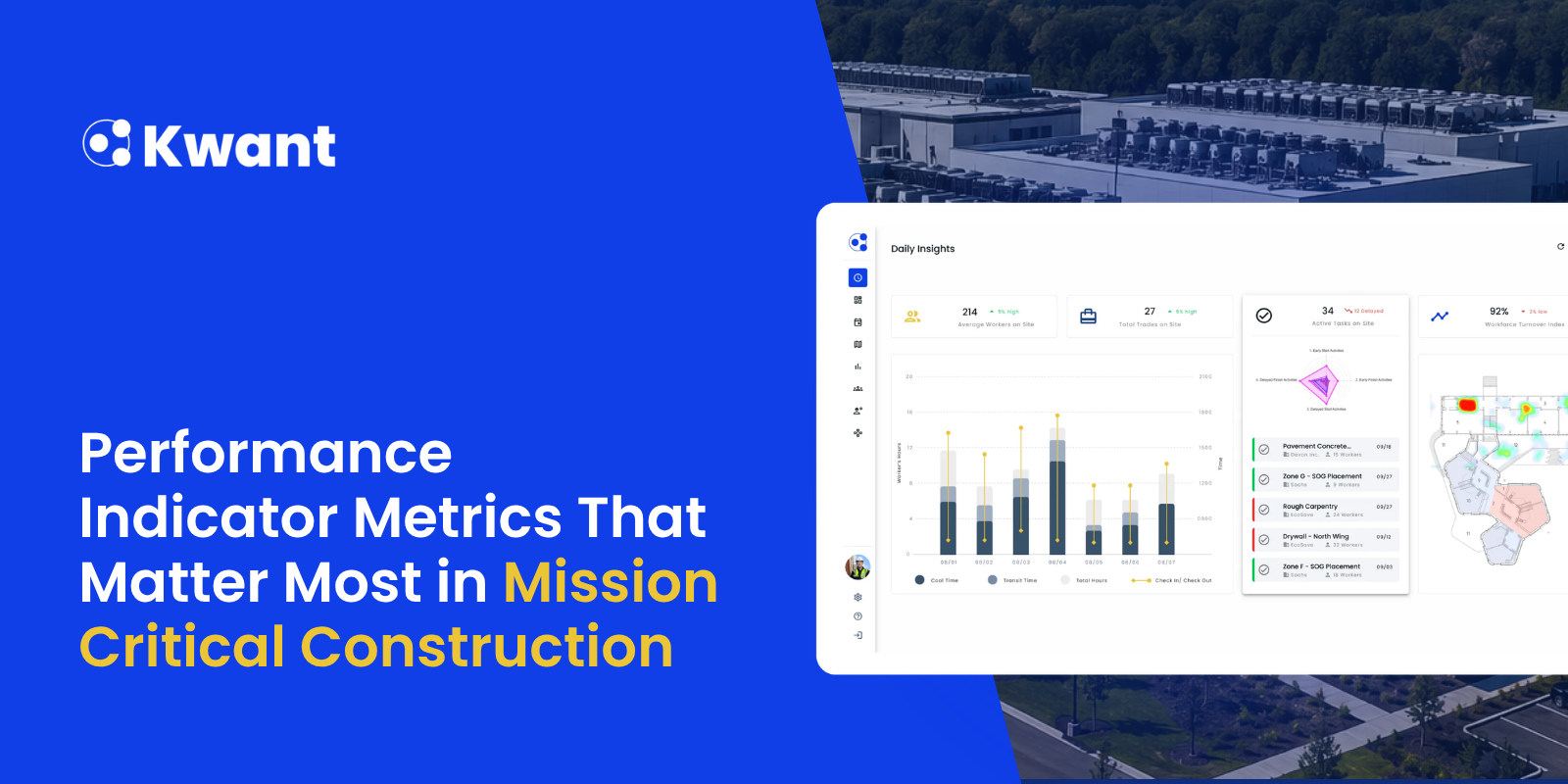
The most valuable workforce metrics on a mission-critical project include:
Daily Manpower vs. Plan: Are actual workforce counts tracking against staffing forecasts? Gaps here are early indicators of schedule risk, not lagging ones.
Crew Utilization Rate: What percentage of scheduled workers are actively on site during productive work hours? Consistently low utilization by a specific contractor is a conversation worth having early.
Gate-to-Gate Workforce Trends: How long are workers on site? How does that vary by trade and shift? Patterns here can surface mobilization inefficiencies or access friction that erodes productive hours.
Trade Distribution by Phase: Is labor deployment aligned with project milestones and commissioning priorities? Understanding which trades are over- or under-resourced relative to the current phase prevents surprises.
Zone Utilization: Where is workforce density concentrated? Are certain areas congested while others are underutilized? This kind of spatial visibility helps site teams coordinate more effectively across large, multi-building campuses.
Credential Compliance Rate: What percentage of the active workforce has all required certifications current? A declining rate is an early warning signal, not a problem you want to discover during an owner audit.
With this data available in real time, project teams shift from asking why are we behind to identifying where risk is building before it becomes a schedule issue.
Learning from Workforce Data Across Projects
Workforce data becomes even more valuable when teams can learn from it across projects, not just within them.
Every data center build generates intelligence: how long onboarding typically takes, which trades ramp slower than forecasted, what labor patterns preceded commissioning delays, which contractors consistently met workforce commitments. But on most projects, that information disappears once the project closes.
Leading mission-critical teams are beginning to approach this differently. Instead of treating workforce data as a reporting exercise, they are using it to improve future execution.
AI-supported analytics are starting to make this practical at scale. Rather than manually sorting through historical reports, teams can identify patterns, benchmark contractor performance, and improve workforce planning before the next project begins. For owners managing multiple campuses or regional programs, that kind of portfolio-level visibility allows leadership to compare labor trends across projects, identify systemic risks, and build more accurate staffing forecasts.
The teams staying ahead are not simply collecting workforce data. They are learning from it.
What to Look for When Evaluating a Platform
Not every workforce solution is built for the security and complexity of data center construction. If you are evaluating options, the capabilities that matter most on mission-critical sites include:
Real-time workforce visibility across zones, buildings, trades, and contractor tiers, not just a daily report.
Automated credential and certification tracking with expiry alerts and access holds that update without manual intervention.
Biometric enrollment to ensure every worker identity is verified. No shared badges, no proxy access.
Zone-based access rules configurable by role, building, shift window, credential status, and security clearance level.
Offline capability, access control and data capture must function when site connectivity drops.
Multi-tier contractor hierarchy visibility, so project teams can see workforce status across GC, subcontractor, and lower-tier labor partners.
Audit-ready reporting that satisfies hyperscaler and owner documentation requirements without manual preparation.
Portfolio-level reporting for owners and enterprise teams managing multiple active projects.
Mobile accessibility so foremen, superintendents, and safety managers can access workforce data in the field.
Kwant supports some of the most complex data center construction environments in the industry including campuses where daily headcounts exceed 3,000 workers across multiple concurrent structures. The goal is not simply workforce tracking. It is helping project teams reduce administrative burden, improve labor visibility, and create more predictable execution on projects where there is little margin for workforce disruption.
Productivity and Compliance Are Not a Trade-Off
The most sophisticated data center builders have moved past the idea that security and productivity compete with each other.
The reality is simpler: you cannot maintain productivity if workforce operations are disorganized. A worker waiting at the gate because credentials were not verified is a productivity problem. A missing certification that delays commissioning is a schedule problem. Poor visibility into labor deployment is a project controls problem.
The best workforce strategies reduce risk and help teams operate faster. Because the same visibility that keeps the wrong people off the jobsite also tells you whether the right people are being deployed effectively.
That balance is becoming one of the clearest differentiators between projects that stay ahead of schedule and projects that are constantly fighting workforce disruptions.
Ready to Improve Workforce Visibility on Your Next Data Center Project?
Managing workforce operations on a mission-critical project requires more than spreadsheets, disconnected systems, or manual reporting.
A modern secure construction workforce platform helps project teams streamline compliance, strengthen access management, improve workforce visibility, and better understand labor performance across a single project or an entire portfolio.
See how leading mission-critical teams are modernizing workforce management for data center construction with Kwant. Book a demo.
Frequently Asked Questions
What is a secure construction workforce platform? A secure construction workforce platform is a centralized digital system that manages worker credentialing, site access, compliance tracking, and workforce visibility in one place. Unlike general HR or contractor management tools, it is purpose-built for the security and compliance requirements of high-stakes construction environments. It typically includes biometric enrollment, real-time access control, automated credential tracking, and audit-ready reporting.
How does workforce compliance software improve data center construction? Workforce compliance software automates the tracking of certifications, safety requirements, orientations, and background checks. Instead of manually managing spreadsheets, teams proactively identify compliance gaps before they disrupt mobilization or delay work. When credentials expire, access holds update automatically where no manual intervention required.
What is the difference between a contractor management system and a workforce visibility platform? A contractor management system typically handles subcontractor prequalification and document collection at the company level. A workforce visibility platform goes further managing individual workers, tracking real-time presence on site, enforcing access rules by zone and role, and providing live productivity data. For data center sites with complex multi-tier contractor networks, you need both functions in one integrated system.
Why is jobsite access management important on data center projects? Data center campuses often have active infrastructure running alongside active construction, with owner-mandated zone separation between contractor tiers. Jobsite access management ensures workers only access approved areas based on role, credentials, shift window, and security clearance and enforces those rules automatically rather than relying on manual badge reviews.
How does productivity tracking improve project outcomes without micromanaging field workers? Productivity tracking on a construction site is about operational clarity, not surveillance. By comparing actual manpower against plan, tracking crew utilization by trade, and monitoring zone deployment, project teams can identify labor shortfalls or deployment mismatches before they become schedule problems. The data helps leadership ask better questions earlier and not monitor individual workers.
How are owners using workforce visibility across multiple projects? Owners managing multiple campuses are using portfolio-level workforce data to compare labor trends, identify systemic staffing risks, benchmark contractor performance, and improve forecasting across future builds. As mission-critical programs expand in scale and complexity, that cross-project intelligence is becoming a meaningful competitive advantage.

.png)
%20(1).svg)


